The Manaslu Circuit Trek takes you through one of Nepal’s more remote Himalayan trekking regions, combining high mountain scenery, traditional villages, Buddhist culture and varied landscapes. The route circles Mount Manaslu (8,163 m) and crosses the challenging Larkya La Pass at 5,106 m, making it a demanding but rewarding trek for experienced walkers.

Manaslu Circuit Trek - 12 Days
Trip Facts
Duration
10 Days
Trip Grade
Difficult
Country
Nepal
Maximum Altitude
5,106 m (Larkya La Pass)
Starts
Kathmandu
Ends
Kathmandu
Group Size
2-20
Activities
Trekking
Best Time
March–May & September–November
Key Highlights of Manaslu Circuit Trek
- Trek around Mount Manaslu (8,163 m) through the remote Himalayan landscape.
- Cross Larkya La Pass (5,106 m), the highest point of the trek.
- Explore the Budhi Gandaki and Nubri Valleys from green foothills to high alpine terrain.
- Visit Pungyen Gompa (4,000 m) with views of Manaslu and surrounding peaks.
- Hike to Birendra Lake and Manaslu Base Camp during the Samagaon acclimatization day.
- Experience traditional Himalayan villages including Namrung, Lho, Shyala, Samagaon and Samdo.
- Discover Tibetan Buddhist heritage through monasteries, chortens, mani walls and prayer flags.
- See Manaslu, Himlung Himal, Cheo Himal and Annapurna II from the higher sections.
- Walk through changing landscapes of forests, terraced hillsides, rocky valleys and glaciers.
- Descend through Bimthang and Dharapani to complete the circuit.
Manaslu Circuit Trek Overview
The Manaslu Circuit Trek – 12 Days is a challenging high-altitude trek in the Manaslu region of north-central Nepal, taking you around Mount Manaslu (8,163 m) through the Budhi Gandaki Valley and the high Nubri Valley. The route combines changing mountain landscapes, forested trails, terraced hillsides, traditional villages and Tibetan Buddhist cultural heritage, including monasteries in the Manaslu Region. As you gain elevation, the scenery gradually changes from green river valleys and woodland to open alpine terrain, with Larkya La Pass at 5,106 m (16,752 ft) marking the highest point of the trek.
The journey begins with a full-day drive from Kathmandu to Machha Khola, passing through Dhading Besi, Arughat and Soti Khola before entering the Budhi Gandaki Valley. The trekking section follows the river through Jagat, Sirdibas, Philim and Deng, before climbing towards Namrung, Lihi, Sho, Lho and Shyala. This section brings a steady increase in altitude, with suspension bridges, forested slopes, mountain villages, cultivated hillsides and views of the surrounding peaks becoming more prominent as you move deeper into the Manaslu region.
From Shyala, the trail climbs towards Pungyen Gompa at approximately 4,000 m (13,123 ft) before descending to Samagaon, an important stop in the upper valley. A dedicated acclimatization day in Samagaon includes a hike towards Birendra Lake and Manaslu Base Camp, reaching approximately 4,800 m (15,748 ft) before returning to the same overnight elevation. The route then continues to Samdo and Dharamsala (Larkya Phedi) through increasingly dry, rocky and exposed terrain, where the surroundings become more rugged as you approach the pass.
The most demanding stage is the crossing of Larkya La Pass, followed by a long descent to Bimthang and onward through Gho and Tilje to Dharapani, where the trekking section ends. As you descend, the surroundings gradually become greener, with forests, cultivated hillsides and lower mountain settlements replacing the high alpine terrain. The journey then continues by road through the Marsyangdi Valley and Besisahar to Kathmandu. Long walking days, steep and uneven sections, high altitude and changing mountain weather are part of the trek, while road conditions and traffic can affect travel times, so careful pacing and some flexibility are useful throughout the journey.
Why Choose the Manaslu Circuit Trek?
The Manaslu Circuit Trek combines high Himalayan scenery, traditional mountain villages, Tibetan Buddhist culture and a challenging high-altitude pass crossing in one journey. The route follows the Budhi Gandaki Valley into the Nubri Valley, continues through Samagaon and Samdo, and crosses Larkya La Pass at 5,106 m (16,752 ft) before descending towards Bimthang and Dharapani.
➥ Trek Around Mount Manaslu
The Manaslu Circuit Trek takes you through the valleys and high mountain terrain surrounding Mount Manaslu (8,163 m), the world's eighth-highest mountain. As you climb through Namrung, Lho, Shyala and Samagaon, views of Manaslu and the surrounding peaks become increasingly prominent.
The higher route towards Dharamsala and Larkya La leads into a more rugged alpine environment, with broad mountain views and exposed high-altitude terrain. The changing viewpoints along the circuit allow you to experience the Manaslu range from several different parts of the journey.
➥ Experience a Wide Range of Landscapes
The trek passes through several distinct environments as the altitude increases. Lower sections follow the Budhi Gandaki River through forests, terraced hillsides, suspension bridges and cultivated areas, while the landscape becomes drier and more open around Samagaon, Samdo and Dharamsala.
After crossing Larkya La, the surroundings change again as you descend towards Bimthang. Rocky slopes and alpine meadows gradually give way to pine, fir and rhododendron forests, creating a clear transition from the high mountain environment to greener lower valleys.
➥ Explore Nubri Valley and Himalayan Culture
The trail passes through traditional settlements in the Nubri Valley, where Tibetan Buddhist traditions remain closely connected with everyday life. Villages such as Namrung, Lho, Shyala, Samagaon and Samdo feature stone houses, monasteries, mani walls, chortens and prayer flags.
Walking through these settlements provides a chance to see how communities have adapted to life in a remote mountain environment. The cultural experience develops throughout the trek through village life, local architecture and religious landmarks rather than being centred on a single cultural site.
➥ Acclimatize at Samagaon
The itinerary includes a dedicated acclimatization day at Samagaon before the route continues towards Samdo and Dharamsala. The planned hike follows the route towards Birendra Lake and Manaslu Base Camp, reaching approximately 4,800 m (15,748 ft) before returning to Samagaon for the night.
The daytime ascent provides additional exposure to higher altitude while allowing you to sleep at the same elevation. It also gives you time to explore the upper mountain landscape around the Manaslu glacier before continuing towards the higher sections of the circuit.
➥ Cross Larkya La at 5,106 m
Crossing Larkya La Pass at 5,106 m (16,752 ft) is the highest and most demanding stage of the trek. The route starts from Dharamsala and climbs steadily through exposed high-altitude terrain before reaching the pass, followed by a long descent towards Bimthang.
An early start is normally required for the crossing, and mountain conditions can change quickly at this elevation. Proper preparation, warm clothing, careful pacing and flexibility are important, particularly when snow, strong winds or poor visibility affect trail conditions.
➥ Trek through Remote Mountain Villages
The Manaslu Circuit passes through remote mountain settlements where traditional village life remains an important part of the journey. Long sections of the route follow forested slopes, river valleys and open high-altitude terrain, with fewer developed facilities than some of Nepal's busier trekking areas.
This combination of mountain scenery, traditional settlements, Buddhist heritage and challenging terrain makes the circuit a varied trekking experience. It allows you to experience the Manaslu region progressively, from the lower Budhi Gandaki Valley to the high Himalayan landscape around Larkya La and back down towards Dharapani.
Where does the Manaslu Circuit Trek begin?
First, you fly into Kathmandu, and we meet you at the airport. Transfer you to your Hotel in a private vehicle. Later, you meet your guide, receive a brief orientation of the trek, and check equipment. The following day, we take a scenic drive to Macha Khola. From there, we follow the Budi Gandaki River upstream through villages like Jagat, Deng, Namrung, and Shyala. From Shyala, we take a detour hike to Pungen Gompa and then move to Samagaon.
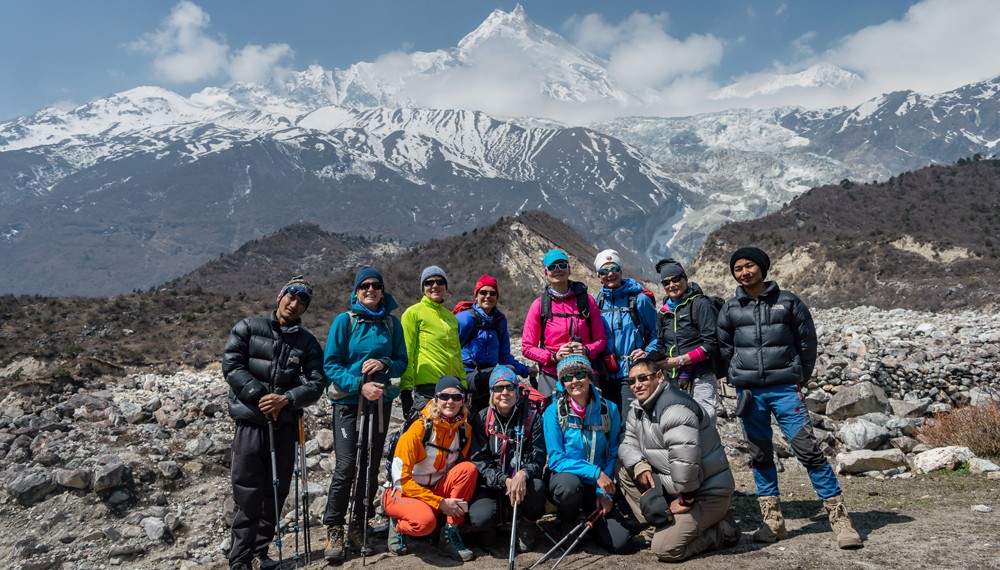
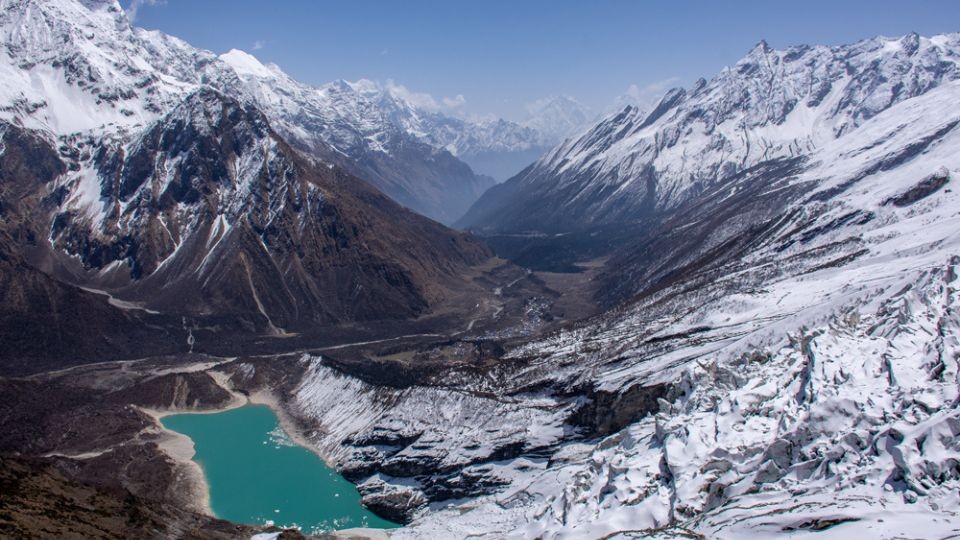
We stop for a day in Samagaon to acclimatise and rest or take side trips like Birendra Lake of Manaslu Base Camp. Then we proceed to Samdo and spend another day resting or take side trips to the Tibetan border and Samdo Peak.
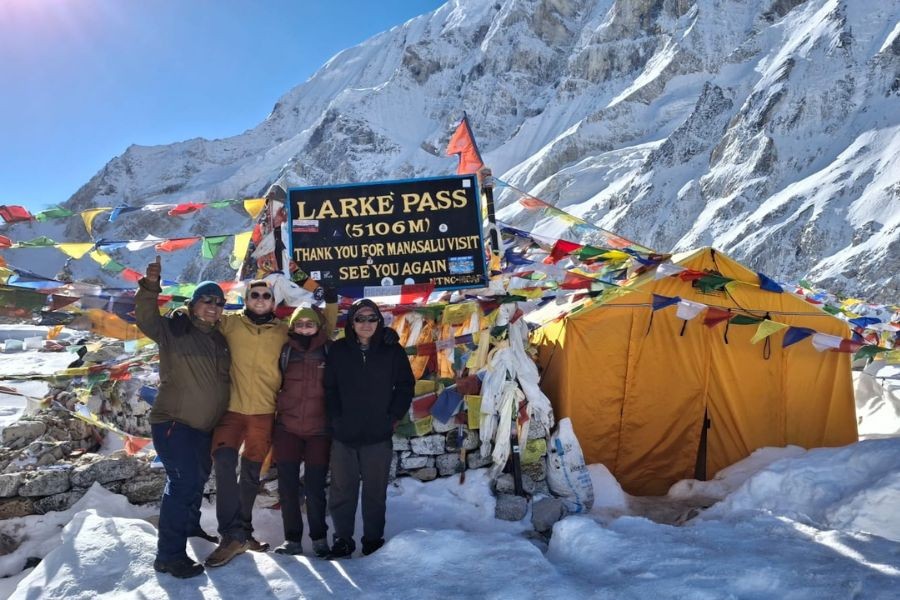
We continue to Dharmasala, where we will spend a night before crossing Larkya La, the highest point of our trek, before proceeding to Bhimtang.
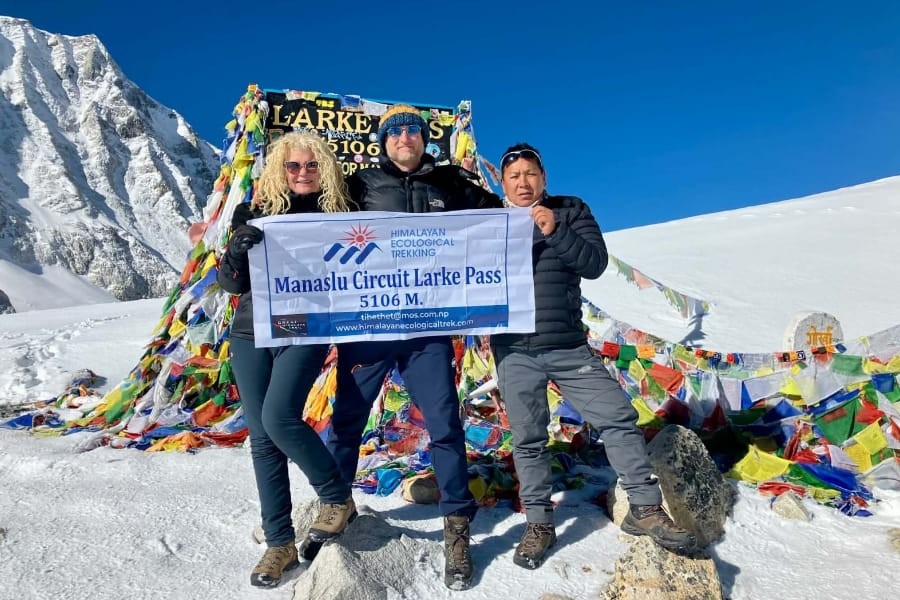
After a final push, we reach Dharapani, where we celebrate our trek completion and drive to Kathmandu the following day. To make this easier to follow, the full Manaslu Circuit itinerary is outlined day by day below.
Benefits of Trekking with Himalayan Ecological Trekking on the Manaslu Circuit Trek
- Airport Transfers: Complimentary private airport pick-up and drop-off are provided at the beginning and end of your trip.
- Experienced Local Guides: Trek with experienced, licensed local guides who understand the Manaslu region, its trails, mountain conditions and local communities.
- Pre-Trek Briefing: Receive an online briefing covering the itinerary, packing requirements, altitude, trekking conditions and other practical preparations before departure.
- Trekking Equipment: Essential equipment such as sleeping bags, down jackets, trekking poles, crampons and water bottles can be provided where applicable and returned after the trek.
- Excess Luggage Storage: Store luggage that you do not need on the trek at the HET office in Kathmandu.
- Waterproof Duffle Bag: When porter service is arranged, a waterproof duffle bag is provided for carrying your trekking gear.
- Communication and Support: Stay in contact with our team through WhatsApp, email and other available communication channels before and during the trek.
- Flexible Group Arrangements: The Manaslu Circuit Trek can be arranged for solo travelers, couples, families and private groups.
- Departure Arrangements: Confirmed departures are operated according to the agreed trekking schedule, subject to necessary permits, weather and local conditions.
- Responsible Trekking: We encourage responsible travel practices to help keep the Manaslu trekking environment clean and support respectful interaction with local communities.
You’ll Explore on the Trail
Manaslu Circuit Trek - 12 Days Itinerary
Day 1
Drive from Kathmandu to Machha Khola (930 m)
Max Altitude: 1,400m (4,593ft)
Duration: Approx. 8–10 hours
Distance: Approx. 160 km
Meals: Lunch & Dinner
Accommodation: Teahouse
Mode of Transportation: Drive
Your Manaslu Circuit Trek begins with a drive from Kathmandu to Machha Khola in the Gorkha district. The road leaves the Kathmandu Valley and passes through Dhading Besi, Arughat and Soti Khola before entering the Budhi Gandaki Valley. Along the way, the surroundings change from busy urban areas to terraced farmland, forested hills, riverside settlements and small market centers. As the route moves deeper into the hills, the landscape becomes quieter and more mountainous.
Beyond Soti Khola, the road becomes rougher, with narrow, uneven and partly unpaved sections in places. The route follows the lower Budhi Gandaki Valley towards Machha Khola, with road conditions, traffic, weather and local construction affecting the journey at times. After arriving, settle into your teahouse and rest for the evening. Machha Khola is the overnight stop before the trekking section begins the following morning.
Day 2
Trek from Machha Khola to Jagat (1,340 m)
Max Altitude: 1,338m (4,389ft)
Duration: Approx. 6–7 hours
Distance: Approx. 14–16 km
Meals: Breakfast, Lunch & Dinner
Accommodation: Teahouse
Mode of Transportation: Trek
After breakfast, begin walking along the Budhi Gandaki River towards Jagat. The trail passes through forests and small settlements, with several suspension bridges and short uphill and downhill sections along the way. Continue through Khorlabesi towards Tatopani, where a natural hot spring area is located near the trail. The route then follows the river through increasingly narrow sections of the valley.
From Tatopani, continue through Doban and other riverside sections before climbing higher above the Budhi Gandaki. Some parts of the trail are cut into steep hillsides, while others pass close to the river. After several hours of walking, arrive at Jagat, a traditional settlement with stone-paved paths and houses. Overnight at a teahouse in the village.
Day 3
Trek from Jagat to Deng (1,860 m)
Max Altitude: 1,860m (6,102ft)
Duration: Approx. 6–8 hours
Distance: Approx. 17–19 km
Meals: Breakfast, Lunch & Dinner
Accommodation: Teahouse
Mode of Transportation: Trek
Leave Jagat after breakfast and continue north through the Budhi Gandaki Valley. The trail passes through Sirdibas and follows a mixture of forested slopes, terraced fields and riverside sections. You cross suspension bridges and walk through several narrow parts of the valley, with regular changes in elevation as the trail follows the contours of the hillside.
After reaching Philim, continue through forest and along the river towards Pewa and Deng. The trail becomes more remote as you move further into the valley, while traditional houses and Buddhist cultural features become more noticeable. Reach Deng in the afternoon and settle into your teahouse for the night.
Day 4
Trek from Deng to Namrung (2,630 m)
Max Altitude: 2,630m (8,628ft)
Duration: Approx. 6–7 hours
Distance: Approx. 15–17 km
Meals: Breakfast, Lunch & Dinner
Accommodation: Teahouse
Mode of Transportation: Trek
The trail continues upstream from Deng towards the higher villages of the Nubri Valley. Walk through forested sections and cross bridges while passing settlements such as Rana and Bihi Phedi. The valley narrows in places, and the route includes rocky climbs, forest trails and sections above the Budhi Gandaki River.
Continue towards Ghap, where the trail passes through woodland and stone-built sections before climbing towards Namrung. As you gain elevation, the valley begins to open and the surrounding mountains become more visible. Arrive at Namrung, where you will spend the night before continuing towards the higher villages of the Manaslu region.
Day 5
Trek from Namrung to Shyala (3,500 m)
Max Altitude: 3,500m (11,482ft)
Duration: Approx. 5–7 hours
Distance: Approx. 13–15 km
Meals: Breakfast, Lunch & Dinner
Accommodation: Teahouse
Mode of Transportation: Trek
After breakfast, continue from Namrung into the upper Nubri Valley. The trail climbs through forest before reaching Lihi, where traditional houses and cultivated fields line the route. From Lihi, continue towards Sho and Lho, following village paths, forested sections and open slopes as the elevation increases.
From Lho, the trail continues towards Shyala. In clear weather, Manaslu and other surrounding peaks can be seen from several points along this section. The higher altitude makes the walk slower than the lower sections of the trek, so keep a steady pace and take regular breaks. After reaching Shyala, check into the teahouse and rest.
Day 6
Trek from Shyala to Samagaon (3,530 m)
Max Altitude: 3,530m (11,581ft)
Duration: Approx. 6–8 hours
Distance: Approx. 15–17 km
Meals: Breakfast, Lunch & Dinner
Accommodation: Teahouse
Mode of Transportation: Trek
Leave Shyala in the morning and follow the trail towards Pungyen Gompa (Pungen Gompa), climbing through open mountain terrain above the valley. The route reaches approximately 4,000 m at Pungyen Gompa, where you can see Manaslu and the surrounding peaks in clear weather. Take the uphill sections steadily and allow enough time to visit the gompa before continuing towards Samagaon.
From Pungyen Gompa, descend and rejoin the trail towards Samagaon. The valley gradually opens as you approach the village, while the landscape becomes drier and more rugged with less vegetation. After reaching Samagaon, check into your teahouse and keep the rest of the day relaxed. Rest well and stay hydrated before the following day's acclimatization hike.
Day 7
Acclimatization Hike from Samagaon to Birendra Lake and Manaslu Base Camp (4,800 m)
Max Altitude: 4,797m (15,738ft)
Duration: Approx. 6–8 hours
Distance: Approx. 10–14 km
Meals: Breakfast, Lunch & Dinner
Accommodation: Teahouse
Mode of Transportation: Trek
Today is set aside for acclimatization before continuing towards Samdo and Dharamsala. After breakfast, walk from Samagaon towards Birendra Lake, a glacial lake below the Manaslu glacier. Trekkers who are comfortable with the additional ascent can continue towards Manaslu Base Camp through rocky and open terrain. The higher section provides closer views of the glaciers and surrounding mountain slopes.
After spending time at the higher point, descend by the same general route and return to Samagaon for the night. The daytime climb gives your body additional exposure to altitude while you continue sleeping at the same elevation. Keep the afternoon relaxed, drink enough water and rest well before moving higher on the following days.
Day 8
Trek from Samagaon to Samdo (3,875 m)
Max Altitude: 3,875m (12,713ft)
Duration: Approx. 3–4 hours
Distance: Approx. 7–8 km
Meals: Breakfast, Lunch & Dinner
Accommodation: Teahouse
Mode of Transportation: Trek
Leave Samagaon after breakfast and follow the upper Budhi Gandaki Valley towards Samdo. The trail climbs gently through open ground as the vegetation becomes thinner and the terrain becomes drier and more rocky. With less forest along the route, you get broader views of the high valley and surrounding ridges.
Continue along the valley until you reach Samdo, a traditional high-altitude settlement near the Tibetan border. At around 3,875 m, it is one of the highest permanent villages on the Manaslu route. Because the walking distance is relatively short, there is time to rest after arrival and conserve energy for the next section towards Dharamsala.
Day 9
Trek from Samdo to Dharamsala (4,460 m)
Max Altitude: 4,460m (14,632ft)
Duration: Approx. 3–5 hours
Distance: Approx. 6–7 km
Meals: Breakfast, Lunch & Dinner
Accommodation: Teahouse
Mode of Transportation: Trek
Today's walk takes you from Samdo to Dharamsala, also known as Larkya Phedi. Leave the village and follow the trail through increasingly barren terrain with sparse vegetation. The route gradually climbs through the upper valley towards the Larkya La approach, with rocky slopes and glacial terrain becoming more common as the elevation increases.
After several hours of steady walking, arrive at Dharamsala, the final overnight stop before crossing Larkya La Pass. Because of the high elevation, keep the afternoon for rest rather than adding unnecessary activity. Prepare your warm clothing, gloves, headlamp and water bottles for the early start required for the pass crossing the next morning.
Day 10
Trek from Dharamsala to Bimthang (3,590 m) via Larkya La Pass (5,106 m)
Max Altitude: 5,105m (16,748ft)
Duration: Approx. 8–10 hours
Distance: Approx. 16–18 km
Meals: Breakfast, Lunch & Dinner
Accommodation: Teahouse
Mode of Transportation: Trek
Start early from Dharamsala for the most demanding day of the Manaslu Circuit Trek. The trail climbs steadily across rough, exposed terrain towards Larkya La Pass. The high altitude makes the ascent slow, and snow or icy sections may be present depending on the season and recent weather. Maintain a steady pace and take short breaks whenever needed rather than trying to climb too quickly.
Reach Larkya La Pass at approximately 5,106 m, the highest point of the trek. In clear weather, the pass provides views of peaks including Annapurna II, Himlung Himal and Cheo Himal. From the pass, begin the long descent towards Bimthang, initially over rocky ground before reaching lower slopes with more vegetation. Take care on loose and uneven sections during the descent before reaching Bimthang for the night.
Day 11
Trek from Bimthang to Dharapani (1,860 m)
Max Altitude: 3,590m (11,778ft)
Duration: Approx. 6–7 hours
Distance: Approx. 16–18 km
Meals: Breakfast, Lunch & Dinner
Accommodation: Teahouse
Mode of Transportation: Trek
After breakfast, leave Bimthang and descend towards Dharapani. The trail passes through open meadows before entering pine, fir and rhododendron forests. As you lose altitude, the vegetation becomes denser and the temperature generally becomes warmer. The route also passes smaller settlements and cultivated areas as it approaches the Marsyangdi Valley.
Continue through Gho and Tilje before reaching Dharapani. The road becomes more noticeable on this section, and Dharapani is an established trail junction connecting routes through the Manaslu and Annapurna regions. After arriving, check into your teahouse and rest after completing the main trekking section of the circuit.
Day 12
Drive from Dharapani to Kathmandu (1,400 m)
Max Altitude: 1,397m (4,583ft)
Duration: Approx. 8–10 hours
Distance: Approx. 220 km
Meals: Breakfast
Accommodation: N/A
Mode of Transportation: Drive
After breakfast, begin the final drive from Dharapani to Kathmandu. The road follows the Marsyangdi Valley towards Besisahar, passing through mountain settlements, terraced hillsides, forests and river valleys. As you descend from the higher trekking areas, the scenery becomes greener and more populated.
From Besisahar, continue by road towards Kathmandu. Travel time can vary depending on traffic, road conditions, weather and local road work, so the journey may take most of the day. After arriving in Kathmandu, your 12-day Manaslu Circuit Trek comes to an end.
Are you still confuse from where to start? We have solutions for you.
No worries — team is ready to guide you everystep of the way.
Altitude Chart
Cost Details
Includes
Transportation
- Complimentary airport pick-up and drop-off in Kathmandu by private vehicle.
- Road transportation from Kathmandu to Machha Khola at the beginning of the trek.
- Road transportation from Dharapani to Kathmandu at the end of the trek.
- Scheduled road transportation as specified in the itinerary.
Accommodation
- 11 nights of accommodation in local teahouses during the trek.
- Standard twin-sharing rooms are provided at trekking teahouses.
- Rooms with attached bathrooms are available where possible, while shared bathroom facilities are common, particularly at higher elevations.
- Teahouse facilities become more basic in the remote and higher sections of the Manaslu Circuit.
Meals & Drinking Water
- 11 breakfasts, 11 lunches and 11 dinners as specified in the itinerary.
- Full-board meals during the scheduled trekking days.
- Freshly prepared meals from available local teahouse menus.
- Safe drinking water support through water purification tablets.
Permits & Entry Fees
- Manaslu Restricted Area Trekking Permit (RAP).
- Manaslu Conservation Area Permit (MCAP).
- Annapurna Conservation Area Permit (ACAP)
- Chumnubri Rural Municipality Local Fee.
- Required local permits and entry fees for the scheduled Manaslu Circuit route.
Guide & Support Staff
- Experienced, government-licensed English-speaking trekking guide with first-aid training and high-altitude trekking experience.
- One assistant guide for groups of more than 10 trekkers.
- Guide and support staff wages, meals, accommodation, transport and required trekking equipment.
Medical & Safety
- First-aid kit carried by the trekking guide.
- Pulse oximeter for basic pulse and oxygen-saturation checks.
- Basic altitude and health monitoring throughout the trek.
- Guidance on acclimatization and recognizing symptoms of altitude illness.
- Emergency assistance and coordination in case of illness or injury.
- Emergency evacuation coordination when required; rescue and evacuation costs should be covered by your travel insurance.
Trek Equipment & Services
- Company duffle bag for use during the trek.
- Warm sleeping bag provided for the trek and returned after completion.
- Trek Completion Certificate.
- Free online trip briefing and pre-booking consultation with Bikesh Rana, Founder and Managing Director of Himalayan Ecological Trekking.
- Pre-trek support in Kathmandu with practical guidance on the route, trekking conditions, equipment and final preparations.
- Assistance with final trek preparations and any last-minute arrangements before departure.
Excludes
International Travel & Visa
- International flights to and from Nepal.
- Nepal tourist visa fees and visa extension charges.
- Other immigration or entry-related fees.
Travel Insurance (Mandatory)
- Personal travel and medical insurance.
- Insurance covering high-altitude trekking up to at least the maximum elevation of the trek.
- Emergency medical treatment, rescue, evacuation and repatriation costs.
Accommodation & Meals
- Accommodation and meals in Kathmandu outside the scheduled itinerary.
- Additional accommodation or meals required before or after the scheduled itinerary.
- Additional accommodation, meals or transport resulting from delays, illness, early return or other unforeseen circumstances.
Personal Expenses
- Personal trekking clothing and equipment.
- Personal toiletries and hygiene products.
- Bottled or additional drinking water.
- Tea, coffee, soft drinks and other personal beverages.
- Hot showers and laundry services.
- Wi-Fi, internet access and device charging.
- SIM cards, mobile data and international calls.
- Snacks, souvenirs, gifts and other personal purchases.
Porter Service, Transport & Additional Charges
- Porter service unless specifically included in your booking.
- Private or additional transportation outside the scheduled itinerary.
- Extra transport or related costs caused by personal itinerary changes, road delays, closures or other circumstances outside the company's control.
Medical & Emergency Costs
- Medical consultations, medicines and hospital treatment.
- Personal medical expenses not covered by your travel insurance.
- Emergency rescue, evacuation or repatriation costs not covered by your travel insurance.
Tips & Other Costs
- Tips for guides, porters, drivers and other support staff.
- Private-room supplements.
- Bank, card or money-transfer charges.
- Any new government fees, taxes or permit charges introduced after booking.
- Any service, activity or expense not specifically listed under “What's Included”.
Dates & Availability
Oscar Moore 2 pax(AU) booked MCT- 13 Days • 12h ago
Luci Wagner (AU) booked Everest View Trek • 2d ago
The cost is 777 USD per person for a group of two.
Join our upcoming Manaslu Circuit Trek. Small group departures are already taking shape, and spaces are limited.
Manaslu permits require a minimum of two foreign trekkers. For solo travellers, we coordinate the grouping based on travel dates. Many trekkers prefer flexible or private arrangements, and departures can be organised accordingly.
If you are travelling alone, just share your estimated travel dates, and we will advise on the best available group options. Or, if you prefer a fully private trek, please feel free to drop a message or email. We're just a button away!
Add-ons
Himalayan Ecological Trekking has been organizing trekking adventures for travelers in Nepal since 1995. We can arrange additional services for travelers who need extra luggage support, private transportation, accommodation in Kathmandu or more time on the trail.
The following optional services are available for the Manaslu Circuit Trek. All add-ons are subject to availability and additional charges.
Porter Service
A porter can be added if you prefer to trek with less weight. The porter carries your main trekking bag between overnight stops, while you carry a small daypack with essentials such as water, snacks, a warm layer, valuables and travel documents.
One porter is provided for every two trekkers and can carry up to 20 kg of combined luggage, with a maximum of 10 kg per trekker. Porter service is not included in the standard package and can be arranged at an additional charge.
Private Transport
The standard itinerary includes road transportation from Kathmandu to Machha Khola at the beginning of the trek and from Dharapani to Kathmandu at the end.
Travelers who prefer greater privacy can upgrade to a dedicated Scorpio or similar 4WD for the scheduled road journeys.
Private transport is available for:
- Kathmandu to Machha Khola
- Dharapani to Kathmandu
A private vehicle can accommodate up to 6 passengers, with capacity for up to 7 passengers depending on luggage, vehicle space and road conditions.
This option provides greater privacy and flexibility and is suitable for families, private groups and travelers who prefer not to share the road journey with other passengers.
Accommodation in Kathmandu
Accommodation in Kathmandu is not included in the standard package unless stated otherwise. We can arrange a hotel before or after the trek based on your preferred location, comfort level and budget.
Accommodation can be arranged on a room-only or bed and breakfast (BB) basis.
Extra Nights
Additional nights can be arranged in Kathmandu or at suitable locations along the trekking route.
An extra night in Kathmandu can be useful before the trek for rest and preparation after your international flight, or after the trek if your international departure is later.
Extra trekking nights can also be added for a slower pace, shorter walking days, additional rest or more time in the traditional villages and mountain landscapes of the Manaslu region. The itinerary, accommodation and meals will be adjusted accordingly.
Trekking Equipment Rental
Selected trekking equipment can be rented before the trek, including sleeping bags, trekking poles, warm jackets and other suitable trekking gear.
Warm clothing and a suitable sleeping bag are particularly useful for the higher sections of the route, including Dharamsala at approximately 4,460 m (14,633 ft) and the Larkya La Pass at 5,106 m (16,752 ft), where temperatures can be very cold.
Trek Extension and Extra Walking Days
The Manaslu Circuit Trek can be extended for travelers who want more time in the mountains.
Additional days can be used to reduce walking hours, allow more rest, add an additional acclimatization day, spend longer in traditional villages or explore suitable areas around the Manaslu region.
A revised itinerary can be prepared based on your preferred walking pace, travel dates and available time.
Note: Optional services are not included in the standard package unless specifically mentioned. All add-ons are subject to availability and additional charges. Please let us know your requirements when booking so that we can confirm the arrangements and applicable costs in advance.
Equipment Lists for Manaslu Circuit Trek - 12 Days
Pack for changing conditions on the Manaslu Circuit Trek – 12 Days, from warmer lower valleys to cold, windy and potentially snowy conditions around Samagaon, Dharamsala and Larkya La Pass, depending on the season and weather. The trek reaches approximately 4,800 m (15,748 ft) during the Manaslu Base Camp acclimatization hike and 5,106 m (16,752 ft) at Larkya La Pass, so warm layers, sturdy trekking boots, sun protection and waterproof clothing are important. Keep your daypack light and carry frequently needed items where they are easy to reach, particularly on the longer walking days and the Larkya La crossing.
Head & Face
- Sun hat or trekking hat
- Warm wool or fleece hat
- Buff or neck gaiter
- UV-protection sunglasses
- SPF 30–50+ sunscreen
- Lip balm with SPF
Upper Body
- Quick-drying trekking T-shirts
- Long-sleeved trekking shirt
- Moisture-wicking or thermal base layer
- Fleece or warm mid-layer
- Down or insulated jacket
- Waterproof and windproof jacket
- Sports bra for women
Hands & Feet
- Lightweight liner gloves
- Warm insulated gloves
- Well-broken-in trekking boots with good grip and ankle support
- Comfortable trekking socks
- Warm socks for higher elevations
- Spare pairs of trekking socks
- Lightweight camp shoes or sandals
- Gaiters, optional for wet, muddy or snowy conditions
Lower Body
- Quick-drying trekking trousers
- Trekking shorts
- Thermal leggings or base layer
- Warm or insulated trekking trousers
- Waterproof overtrousers
- Comfortable quick-drying underwear
Sleeping & Trekking Gear
- Warm sleeping bag (provided by the company)
- Waterproof duffle bag (provided by the company)
- Sleeping-bag liner, optional
- Daypack (25–35 litres) with rain cover
- Lightweight, collapsible trekking poles
- Reusable water bottles or hydration bladder (2–3 litre capacity)
- Insulated water bottle or thermos, optional
- Waterproof or dry bags for clothing, valuables and documents
- Small padlock
- Earplugs, optional
Documents & Money
- Passport
- Nepal visa or required visa documents
- Travel insurance details
- Copies of permits and booking documents
- Copies of important travel documents
- Emergency contact details
- Nepalese Rupees in cash
- Credit or debit card
First Aid & Medication
- Basic first-aid kit and pulse oximeter (provided by the company)
- Personal prescription medication
- Blister treatment
- Plasters and adhesive bandages
- Medical tape
- Antiseptic wipes
- Pain-relief medication, if suitable for you
- Oral rehydration salts
- Cough drops or throat lozenges
- Any altitude medication, if prescribed
- Personal medical information and emergency contact details
Electronics & Accessories
- Smartphone or camera
- Headlamp with spare batteries
- Power bank
- Charging cables
- Universal travel adapter
- Spare batteries, if required
- Offline GPS or map app
- Camera accessories, optional
Optional Items
- Binoculars
- Extra snacks
- Book or e-reader
- Travel pillow
- Small notebook and pen
- Headphones or earbuds
Essential Information
Useful Information about the Manaslu Circuit Trek
The Manaslu Circuit Trek – 12 Days is a challenging Himalayan trek in the Manaslu region of northern Gorkha, centred around Mount Manaslu at 8,163 m and the remote valleys on the eastern side of the circuit. The route combines changing mountain landscapes, traditional villages, Buddhist monasteries and high-altitude trails, beginning with a road journey from Kathmandu to Machha Khola and continuing through Jagat, Deng, Namrung, Shyala, Samagaon, Samdo and Dharamsala before crossing Larkya La Pass at 5,106 m (16,752 ft). After the pass, the trail descends through Bimthang and Dharapani before returning to Kathmandu by road. The itinerary uses road transport rather than domestic flights and includes a dedicated acclimatization day at Samagaon, making it important to prepare for long walking days, changing weather, basic mountain accommodation and the more remote conditions found in the upper Manaslu region.
Before Your Manaslu Circuit Trek
A little preparation in Kathmandu will make the start of your Manaslu Circuit Trek – 12 Days easier and more organised. Before leaving for Machha Khola, make sure your travel documents, trekking equipment, personal essentials and baggage arrangements are ready. You will also have an opportunity to meet your trekking team, review the itinerary and complete any final preparations before beginning the long road journey.
What Should You Do Before Starting the Manaslu Circuit Trek?
Before leaving Kathmandu for Machha Khola, make sure you have the essential items and documents ready for the trek. You should:
- Carry a valid passport and Nepal visa or other applicable entry documents.
- Keep your travel insurance policy and emergency assistance details accessible.
- Check your trekking boots, warm layers, rain protection and essential equipment before departure.
- Prepare a comfortable daypack for the items you will carry while walking.
- Keep your passport, permits, money, medication and valuables secure.
- Make sure your main trekking baggage is packed within the agreed porter limit if you are using porter service.
- Inform us in advance about dietary requirements, allergies or special arrangements.
- Complete last-minute shopping, equipment rental or other preparations in Kathmandu.
- Get enough rest before the trek, particularly because the first day involves a long road journey.
- Keep important contact details on your phone and carry a backup copy where practical.
The trek gradually reaches higher elevations and eventually crosses Larkya La Pass at 5,106 m, so suitable warm clothing, reliable footwear and good sun protection are important. You should also be prepared for several days of sustained walking on uneven mountain trails, including the long pass-crossing day from Dharamsala to Bimthang.
Airport Pick-up and Hotel Transfer in Kathmandu for the Manaslu Circuit Trek
Himalayan Ecological Trekking provides complimentary airport pick-up and transfer to your hotel in Kathmandu by private vehicle. After arriving at Tribhuvan International Airport (TIA), our representative will meet you and transfer you to your hotel.
After checking in, you can rest from your international journey and begin your final preparations for the Manaslu Circuit Trek. You can use this time to check your equipment, organise your baggage and complete any last-minute arrangements.
Kathmandu accommodation is not included in the standard trekking package unless specifically stated in your booking. When required, Himalayan Ecological Trekking can arrange suitable hotel accommodation based on your preferred location, comfort level and budget.
Note: Please provide your confirmed international flight details before arrival so we can arrange your airport pick-up. Inform us as soon as possible if your flight schedule changes.
Manaslu Circuit Trek Pre-Trek Briefing in Kathmandu
Himalayan Ecological Trekking arranges a pre-trek briefing in Kathmandu before you leave for Machha Khola. Your guide or HET representative will review the main arrangements for the trek and answer any final questions before departure.
The briefing is particularly useful for checking your equipment, confirming the walking schedule and making sure you understand the practical arrangements for the Manaslu Circuit Trek – 12 Days.
What Happens During the Pre-Trek Briefing for the Manaslu Circuit Trek?
The briefing covers:
- The final itinerary and daily walking schedule
- The Kathmandu–Machha Khola road journey
- The trekking route from Machha Khola through the Manaslu region
- Accommodation and meal arrangements
- Required trekking permits and documents
- Baggage arrangements and porter service, where applicable
- Recommended trekking gear, clothing and footwear
- Preparation for walking on uneven mountain trails
- Altitude gain towards Samagaon, Samdo and Dharamsala
- The purpose of the Samagaon acclimatization day
- The Larkya La Pass crossing and higher-altitude conditions
- Weather and general trail conditions
- Your daypack and main luggage arrangements
- Any personal requirements or special arrangements
- Final questions before leaving Kathmandu
The briefing also gives you time to meet your guide, check your trekking equipment and clarify any questions about the itinerary before the road journey begins.
Getting to and Returning from the Manaslu Circuit Trek
The Manaslu Circuit Trek begins and ends with road travel from Kathmandu. The trekking section starts at Machha Khola and follows the Budhi Gandaki Valley through Jagat, Deng and Namrung before entering the higher mountain settlements around Samagaon and Samdo. After crossing Larkya La and descending to Dharapani, the itinerary returns to Kathmandu by road through the lower valleys.
How Do You Get to the Manaslu Circuit Trek Starting Point?
The trek begins with a road journey from Kathmandu to Machha Khola, in the lower Budhi Gandaki Valley.
The route generally follows:
Kathmandu → Dhading Besi → Arughat → Soti Khola → Machha Khola
The road passes from the Kathmandu Valley into rural hill country, with changing views of terraced farmland, villages, forests and river valleys. As you travel beyond Soti Khola, the road becomes more rugged as it follows the Budhi Gandaki Valley towards Machha Khola
What Is the Drive from Kathmandu to Machha Khola Like on the Manaslu Circuit Trek?
The journey is a long mountain road trip rather than a short transfer. The first part follows major roads before turning onto increasingly winding and uneven hill roads.
As the route approaches Machha Khola, the surroundings become more remote, with steep hills, river valleys, small settlements and sections of rougher road. The journey provides a gradual transition from the busy Kathmandu Valley to the mountain environment where the trekking section begins.
How Long Does the Kathmandu to Machha Khola Journey Take for the Manaslu Circuit Trek?
The drive from Kathmandu to Machha Khola is planned for approximately 8–10 hours, although actual travel time can vary.
Traffic, road conditions, local construction, vehicle movement and stops along the way can all affect the duration. It is therefore better to treat the journey time as an approximate guide rather than a fixed travel schedule.
What Road Conditions Should You Expect on the Way to Machha Khola During the Manaslu Circuit Trek?
Road conditions vary considerably along the route. The main highway sections are generally easier, while the road closer to Machha Khola becomes narrower, rougher and more uneven in places.
You may encounter rocky sections, potholes, winding hill roads and slower-moving traffic as the route follows the Budhi Gandaki Valley. Local road construction can also change the condition of particular sections.
A flexible approach is useful because the actual journey may take longer than planned when road or traffic conditions are difficult.
How Do You Return from Dharapani to Kathmandu After the Manaslu Circuit Trek?
After completing the final trekking section at Dharapani, you begin the return road journey to Kathmandu through Besisahar and the lower hill areas.
The itinerary allows approximately 8–10 hours for this journey, covering around 200–220 km, although the actual duration depends on traffic, road conditions, stops and local travel conditions.
What Is the Road Journey from Dharapani to Kathmandu Like?
The journey begins after the mountain trekking section and gradually descends towards lower valleys. The road includes winding hill sections before connecting with the larger road network towards Kathmandu.
Because it is a long overland journey, it is sensible to keep some flexibility when planning onward travel from Kathmandu, particularly if you have an international flight soon after the trek.
Can Road Travel Cause Delays During the Manaslu Circuit Trek?
Yes. Road conditions, traffic, construction work, weather and local disruptions can affect travel times at both ends of the trek.
The road to Machha Khola can be particularly sensitive to seasonal conditions, while the journey from Dharapani to Kathmandu can also take longer than planned. It is therefore advisable to leave some flexibility around onward travel arrangements.
Manaslu Circuit Trek Route, Elevation and Walking Requirements
The Manaslu Circuit Trek follows a combination of river valleys, forests, terraced hillsides, traditional mountain settlements and high alpine terrain. The trail gradually gains elevation from Machha Khola through Jagat, Deng and Namrung to Samagaon, then continues towards Samdo and Dharamsala before the major Larkya La crossing. After reaching the pass, the route descends through Bimthang and Dharapani.
What Is the Route of the Manaslu Circuit Trek?
The complete route is:
Kathmandu → Machha Khola → Jagat → Deng → Namrung → Shyala → Samagaon → Samdo → Dharamsala → Larkya La Pass → Bimthang → Dharapani → Kathmandu
The trekking section begins at Machha Khola and follows the Budhi Gandaki Valley through Jagat, Deng and the upper valley settlements. From Namrung onwards, the scenery and architecture increasingly reflect the Tibetan Buddhist character of the higher Manaslu region.
After reaching Samagaon, the itinerary includes a dedicated acclimatisation day with a higher-altitude hike towards Birendra Lake and Manaslu Base Camp. The route then continues through Samdo and Dharamsala before crossing Larkya La and descending towards Bimthang and Dharapani.
What Are the Main Places and Elevations on the Manaslu Circuit Trek?
The main points along the route are:
|
Place |
Approx. Elevation |
|
Machha Khola |
930 m |
|
Jagat |
1,340 m |
|
Deng |
1,860 m |
|
Namrung |
2,630 m |
|
Shyala |
3,500 m |
|
Samagaon |
3,530 m |
|
Pungyen Gompa |
4,000 m |
|
Manaslu Base Camp |
Approx. 4,800 m |
|
Samdo |
3,875 m |
|
Dharamsala (Larkya Phedi) |
4,460 m |
|
Larkya La Pass |
5,106 m |
|
Bimthang |
Approx. 3,590 m |
|
Dharapani |
1,860 m |
Elevations are approximate and can vary slightly between maps, trail measurements and local references.
What Is the Highest Elevation Reached on the Manaslu Circuit Trek?
The highest elevation reached on the Manaslu Circuit Trek – 12 Days is Larkya La Pass at 5,106 m (16,752 ft).
The pass is crossed on Day 10 from Dharamsala to Bimthang. This is the highest point of the itinerary and also one of its most demanding sections because of the altitude, long walking hours and changing mountain conditions.
How Many Kilometres or Miles Do You Walk During the Manaslu Circuit Trek?
Based on the approximate distances in the detailed itinerary, the trek covers approximately 133–149 km (83–93 miles) on foot.
The approximate walking distances are:
|
Day |
Route |
Approx. Distance |
|
Day 2 |
Machha Khola → Jagat |
14–16 km |
|
Day 3 |
Jagat → Deng |
17–19 km |
|
Day 4 |
Deng → Namrung |
15–17 km |
|
Day 5 |
Namrung → Shyala |
13–15 km |
|
Day 6 |
Shyala → Pungyen Gompa → Samagaon |
15–17 km |
|
Day 7 |
Samagaon → Birendra Lake → Manaslu Base Camp → Samagaon |
10–14 km |
|
Day 8 |
Samagaon → Samdo |
8 km |
|
Day 9 |
Samdo → Dharamsala |
7 km |
|
Day 10 |
Dharamsala → Larkya La → Bimthang |
16–18 km |
|
Day 11 |
Bimthang → Dharapani |
18 km |
This estimate covers the trekking sections only. The Kathmandu–Machha Khola and Dharapani–Kathmandu road journeys are not included in the walking distance.
How Many Hours Do You Walk Each Day on the Manaslu Circuit Trek?
Walking time varies according to the terrain, trail condition, individual pace and rest breaks.
|
Day |
Route |
Approx. Walking Time |
|
Day 1 |
Kathmandu → Machha Khola by road |
Road journey |
|
Day 2 |
Machha Khola → Jagat |
6–7 hours |
|
Day 3 |
Jagat → Deng |
6–8 hours |
|
Day 4 |
Deng → Namrung |
6–7 hours |
|
Day 5 |
Namrung → Shyala |
5–7 hours |
|
Day 6 |
Shyala → Pungyen Gompa → Samagaon |
6–8 hours |
|
Day 7 |
Samagaon → Birendra Lake → Manaslu Base Camp → Samagaon |
6–8 hours |
|
Day 8 |
Samagaon → Samdo |
3–4 hours |
|
Day 9 |
Samdo → Dharamsala |
3–5 hours |
|
Day 10 |
Dharamsala → Larkya La → Bimthang |
8–10 hours |
|
Day 11 |
Bimthang → Dharapani |
6–7 hours |
|
Day 12 |
Dharapani → Kathmandu by road |
Road journey |
Note: Walking times are approximate and can change according to the trail, weather, rest breaks and individual pace. Day 10 is the longest and most demanding walking day because it includes the Larkya La crossing.
How Difficult Is the Manaslu Circuit Trek?
The Manaslu Circuit Trek is graded challenging. The route does not involve technical mountaineering, but you should be comfortable walking for several hours on uneven mountain trails and handling substantial changes in elevation.
The difficulty comes from the combination of long walking days, repeated uphill and downhill sections, rugged trail surfaces, increasing altitude and remote mountain conditions. The Larkya La crossing at 5,106 m adds an additional challenge, particularly if weather or trail conditions are difficult.
Is the Manaslu Circuit Trek Suitable for Beginners?
The trek can be completed by fit and well-prepared beginners, but it is not an easy introductory trek. Previous multi-day trekking experience is helpful because the itinerary includes several days of 6–8 hours of walking and a high-altitude pass crossing.
Beginners should be comfortable with sustained uphill and downhill walking and should prepare in advance for the physical demands of the route.
How Can You Prepare for the Manaslu Circuit Trek?
Preparation should include regular walking, uphill exercise and longer weekend hikes before departure. Building endurance is especially useful because several days involve sustained walking rather than short village-to-village walks.
It is also useful to practise walking with the daypack you intend to use, break in your trekking boots before the trek and prepare for cold, wet, windy and changeable conditions.
Which Days Are the Most Demanding on the Manaslu Circuit Trek?
The more demanding sections generally include:
- Day 6: Shyala → Pungyen Gompa → Samagaon
- Day 7: Samagaon → Birendra Lake → Manaslu Base Camp → Samagaon
- Day 9: Samdo → Dharamsala Day 10: Dharamsala → Larkya La → Bimthang
Day 10 is generally the key physical challenge because of the 5,106 m altitude, long walking duration and substantial ascent and descent involved in crossing the pass.
Teahouse Accommodation on the Manaslu Circuit Trek
Accommodation on the Manaslu Circuit Trek is provided in local teahouses along the route. The package includes 11 nights of teahouse accommodation, normally on a twin-sharing basis. Facilities become simpler as you travel deeper into the Manaslu region and reach higher elevations.
Where Do You Stay During the Manaslu Circuit Trek?
Your overnight stays are arranged in teahouses at the locations included in the detailed itinerary, from Machha Khola and Jagat through Deng, Namrung, Shyala, Samagaon, Samdo and Dharamsala, before descending to Bimthang and Dharapani.
Accommodation is selected according to the location, availability and local operating conditions. In the more remote sections of the Manaslu Circuit, teahouses are simpler and the number of available lodges is more limited than in larger trekking destinations.
What Type of Teahouse Accommodation Can You Expect on the Manaslu Circuit Trek?
Teahouses are generally simple mountain lodges designed around the practical needs of trekkers. Most provide basic bedrooms, a communal dining area and shared bathroom facilities.
The standard arrangement is twin-sharing accommodation. Attached bathrooms may be available at some lower or better-equipped lodges, but shared facilities are more common at higher elevations.
What Are the Rooms Like on the Manaslu Circuit Trek?
Rooms are usually simple and furnished with twin beds, mattresses and basic bedding. Storage space may be limited, especially in smaller village teahouses.
Bedrooms are generally not heated, so they can become cold after sunset. A warm sleeping bag and suitable night-time clothing are therefore important, especially in the upper parts of the route.
Are Private Rooms and Attached Bathrooms Available on the Manaslu Circuit Trek?
Twin-sharing rooms are the standard accommodation arrangement on the trek.
Private rooms may be available at some teahouses depending on the property, season and availability, but they cannot be guaranteed at every overnight stop. Attached bathrooms are also limited, particularly in remote and higher sections, so shared bathrooms are more common.
What Facilities Are Available at Manaslu Teahouses During the Trek?
Facilities vary between teahouses and generally become more basic as you reach higher and more remote areas.
|
Facility |
What to Expect |
|
Bathrooms |
Mainly shared facilities at higher elevations |
|
Hot Showers |
Available at some stops for an additional charge |
|
Electricity |
Available in many villages, but access can vary |
|
Device Charging |
May require an additional fee |
|
Dining Area |
Shared communal dining areas |
|
Heating |
Generally provided in communal dining areas |
|
Wi-Fi |
Limited and unreliable in remote sections |
|
Mobile Network |
Varies considerably along the route |
Facilities, availability and additional charges can change according to the individual teahouse, season and local conditions.
What Is Accommodation Like at Dharamsala During the Manaslu Circuit Trek?
Dharamsala, also known as Larkya Phedi, at approximately 4,460 m is one of the most remote and basic overnight stops on the circuit.
The accommodation is simpler than in lower villages, with limited facilities and colder conditions. The main purpose of the overnight stay is to provide a practical place to rest before the Larkya La crossing, so travellers should expect basic mountain accommodation rather than modern hotel-style facilities.
Is Kathmandu Accommodation Included in the Manaslu Circuit Trek Package?
Kathmandu accommodation is not included in the standard trekking package unless specifically stated in your booking.
Himalayan Ecological Trekking can arrange suitable hotel accommodation in Kathmandu when required, based on your preferred location, comfort level and budget.
Can You Request Private or Upgraded Accommodation on the Manaslu Circuit Trek?
Private or upgraded accommodation may be possible at selected overnight stops, depending on the lodge and availability.
However, options are more limited in remote sections, particularly around Samdo and Dharamsala. Requests can be made when booking, but final arrangements depend on availability at the individual teahouse.
Food, Drinking Water and Meals During the Manaslu Circuit Trek
Food and drinking water are available from teahouses and local stops along the route from Machha Khola through Samagaon, Samdo and Dharamsala to Dharapani. Meals are generally simple, filling and suitable for trekking, with a combination of Nepali staples, Tibetan-style dishes and familiar lodge meals.
What Food Is Available During the Manaslu Circuit Trek?
Teahouses generally provide a selection of meals suitable for long walking days. Common options include:
- Dal bhat
- Rice and fried rice
- Noodles and chow mein
- Pasta and macaroni
- Potatoes
- Soup and thukpa
- Momo
- Eggs
- Tibetan bread
- Porridge and cereal
- Pancakes
- Toast
- Vegetable dishes
- Local dairy products where available
The exact menu depends on the teahouse and the food supplies available in each village. Choices generally become more limited in the higher and more remote sections of the circuit.
What Do You Eat for Breakfast, Lunch and Dinner During the Manaslu Circuit Trek?
Meal choices vary by teahouse, but you can generally expect:
|
Meal |
Common Options |
|
Breakfast |
Porridge, eggs, pancakes, Tibetan bread, toast, cereal, potatoes, tea and coffee |
|
Lunch |
Dal bhat, noodles, fried rice, pasta, soup, momo, potatoes and other available lodge meals |
|
Dinner |
Dal bhat, noodles, rice, pasta, soup, vegetables, potatoes and other available teahouse meals |
Breakfast is usually taken before beginning the day's walk. Lunch is generally served at a teahouse or stopping point along the trail, while dinner is provided at the lodge where you stay.
Are Vegetarian and Vegan Meals Available During the Manaslu Circuit Trek?
Vegetarian meals are commonly available along the route, including vegetable dal bhat, noodles, fried rice, pasta, potato dishes and soups.
Vegan choices may also be available, although options can become more limited in smaller and more remote teahouses. Some dishes may contain milk, butter, cheese or eggs, so it is useful to check ingredients when ordering.
Please tell us about any dietary requirements or food allergies before the trek so we can inform the teahouses and discuss suitable meal options in advance.
What Local and Tibetan-Style Foods Can You Try During the Manaslu Circuit Trek?
The strong Himalayan and Tibetan Buddhist character of the upper Manaslu region is reflected in some of the food served along the route. Depending on the village and teahouse, you may find:
- Tibetan bread
- Thukpa
- Momo
- Noodles
- Potatoes
- Rice dishes
- Simple vegetable preparations
- Local dairy products where available
Food choices become more limited in higher settlements, so travellers should be prepared for simple teahouse meals rather than a large restaurant-style menu.
How Do You Get Drinking Water During the Manaslu Circuit Trek?
Water can generally be obtained from teahouses and suitable local refill points along the route. Carry a reusable bottle or hydration system so you can refill when appropriate.
Boiled water may be available from teahouses for an additional charge. Bottled water may also be available in some settlements, but using refillable bottles and water purification methods is a more practical option for a long mountain trek.
How Can You Purify Water During the Manaslu Circuit Trek?
Water from untreated natural sources should be purified before drinking. Practical options include:
- Water purification tablets
- Portable water filters
- Boiled water from teahouses
The package includes water purification tablets. Follow the manufacturer's instructions when using them, and ask your guide about suitable refill points along the route.
How Much Water Should You Carry Each Day on the Manaslu Circuit Trek?
Carrying around 2–3 litres of water capacity is practical for most walking days, with refills when suitable sources are available.
Your actual water requirement depends on walking duration, temperature, terrain and individual needs. On longer or higher-altitude days, particularly around Dharamsala and Larkya La, carry enough water for the expected distance between reliable refill points.
What Snacks Are Useful During the Manaslu Circuit Trek?
Light snacks are useful between meals, especially on longer walking days. Practical options include:
- Nuts
- Dried fruit
- Chocolate
- Energy bars
- Biscuits
- Trail mix
- Other lightweight snacks you normally enjoy
You can also bring favourite snacks from Kathmandu, particularly when you have specific dietary preferences.
Best Seasons and Weather Conditions for the Manaslu Circuit Trek
The Manaslu Circuit Trek – 12 Days passes through several elevations, so weather conditions change noticeably as the route climbs from the lower Budhi Gandaki Valley to Samagaon, Dharamsala and Larkya La. Choosing a suitable season can make a significant difference to trail conditions, mountain visibility and overall comfort during the trek.
When Is the Best Time for the Manaslu Circuit Trek?
The recommended seasons for the Manaslu Circuit Trek are March to May and September to November. These periods generally provide more favourable trekking conditions, although mountain weather can still vary from day to day.
March and April can still be cold in the upper sections, while late spring becomes warmer in the lower valleys. Autumn generally brings cooler conditions and often good mountain visibility, although weather is never guaranteed.
What Is the Weather Like During the Manaslu Circuit Trek?
Weather conditions on the Manaslu Circuit Trek vary with both altitude and season. The lower sections around Machha Khola and Jagat are generally warmer, while temperatures drop significantly around Samagaon, Samdo and Dharamsala. Conditions become colder and more exposed as the trail approaches Larkya La Pass.
Mountain weather can change quickly during the day, affecting cloud cover, wind, temperature and visibility. Even in the main trekking seasons, mountain views depend on daily conditions, so it is useful to allow some flexibility in your plans.
What Is Spring Like on the Manaslu Circuit Trek?
Spring (March–May) brings mild temperatures at lower elevations, rhododendron blooms along the forested sections and generally favourable trekking conditions. The higher parts of the route can offer clear mountain views, although conditions vary with altitude and daily weather. The following are some of the main features of trekking in spring:
- Rhododendron blooms at lower and mid elevations
- Mild temperatures at lower elevations
- Clear mountain views on favourable days
- Popular trekking season with more travellers on the trail
For more seasonal details: Manaslu Circuit Trek in Spring
What Is Autumn Like on the Manaslu Circuit Trek?
Autumn (September–November) is one of the most popular seasons for the Manaslu Circuit Trek, with generally stable weather, good visibility and mild temperatures at lower elevations. Trails are often drier after the monsoon, while the higher sections can provide clear views of the surrounding mountains. The following are some of the main features of trekking in autumn:
- Clear mountain views on favourable days
- Generally stable weather conditions
- Mild daytime temperatures at lower elevations
- Drier trails across many sections of the route
- Peak trekking season with more travellers on the trail
For more seasonal details: Manaslu Circuit Trek in Autumn
What Is the Monsoon Like on the Manaslu Circuit Trek?
Monsoon (June–August) brings frequent rainfall to the lower sections of the Manaslu Circuit Trek, with wet trails, leeches and cloud cover common along the route. Heavy rain can affect trail and road conditions, increase the risk of landslides and reduce mountain visibility. The following are some of the main features of trekking during the monsoon:
- Frequent rain and leeches in the lower sections
- Wet and slippery trails after rainfall
- Cloudy conditions that can limit mountain views
- Possible landslides and road disruptions during heavy rain
- Fewer trekkers and limited teahouse services in some areas
For more seasonal details: Manaslu Circuit Trek in Summer-Monsoon
What Is Winter Like on the Manaslu Circuit Trek?
Winter (December–February) brings colder temperatures and more demanding conditions, particularly at higher elevations. Snow and icy conditions can affect the trail around Larkya La Pass, while some teahouses in higher areas may operate with limited services or close during the coldest periods. The following are some of the main features of trekking in winter:
- Cold temperatures, especially at higher elevations
- Snow and icy conditions around Larkya La Pass
- Limited teahouse services in some higher areas
- Fewer trekkers on the trail than in peak seasons
- Warm, layered clothing and suitable winter trekking gear required
For more seasonal details: Manaslu Circuit Trek in Winter
Note: Spring and autumn generally offer favourable trekking conditions, with good mountain visibility, manageable temperatures at lower elevations and better availability of services along the route.
For more seasonal information:
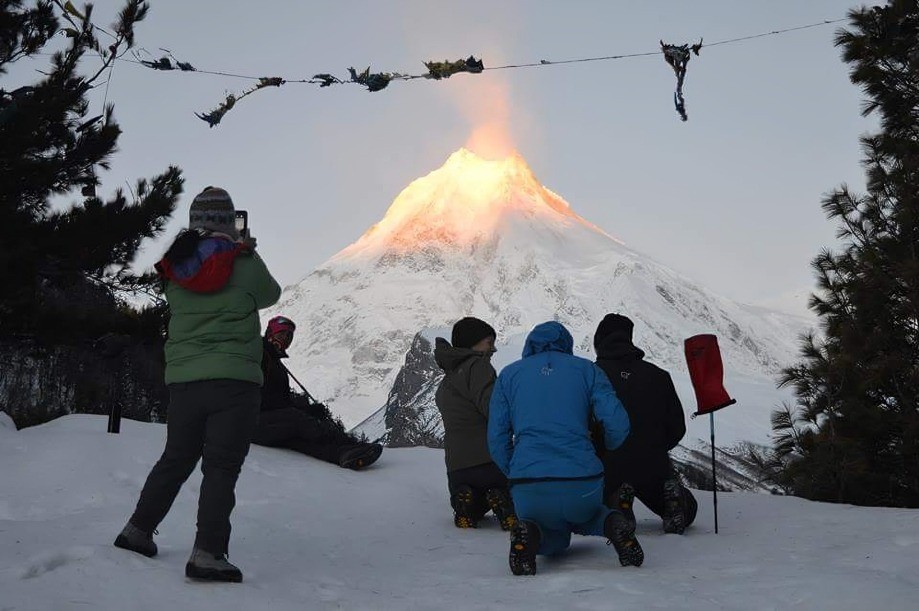
How Cold Can It Get Around Dharamsala and Larkya La During the Manaslu Circuit Trek?
Dharamsala at approximately 4,460 m can be very cold, especially during the night and before sunrise. Temperatures around Larkya La can also remain extremely cold because of altitude, wind and exposure.
Warm layers, thermal clothing, gloves, a warm hat, an insulated jacket and a suitable sleeping bag are important for this part of the route.
Can Snow Affect the Upper Manaslu Circuit Route?
Yes. Snow can affect Dharamsala, Larkya La and nearby high-altitude sections, particularly during winter and periods of heavy snowfall.
Snow is not guaranteed, but when present it can make the trail slippery, slower and more difficult to follow. Your guide assesses actual trail and weather conditions before the pass crossing.
When Are Mountain Views Usually Clearest on the Manaslu Circuit Trek?
Mountain views are generally more reliable during spring and autumn, particularly during clear mornings.
Visibility depends on daily cloud, wind, haze and weather conditions. Early morning often offers clearer mountain views, although conditions can change quickly.
How Can Weather Conditions Change During a Trekking Day on the Manaslu Circuit Trek?
Mountain weather can shift quickly, especially at higher elevations. A clear morning can become cloudy, windy or colder later in the day, while temperatures can fall rapidly after sunset.
It is therefore useful to carry warm layers and rain protection throughout the trek, even when the day begins with favorable weather.
Permits, Documents and Travel Insurance for the Manaslu Circuit Trek
The Manaslu Circuit Trek enters the regulated Manaslu trekking area and passes through the Manaslu Conservation Area, so the required trekking permits and registrations must be arranged before starting the trek. Himalayan Ecological Trekking handles the applicable trekking documentation and permit arrangements for the scheduled itinerary.
What Documents Do You Need for the Manaslu Circuit Trek?
You should have:
- A valid passport
- Nepal visa or applicable entry documentation
- Travel insurance policy details
- Emergency assistance and emergency contact information
- Trekking company and guide contact details
- Required trekking permits and registrations
- Digital or printed copies of important travel documents
Keep your passport and important trekking documentation accessible during the trek rather than packing them deep inside your main luggage.
What Are the Passport and Nepal Visa Requirements for Nepal for the Manaslu Circuit Trek?
Your passport should be valid for at least six months when travelling to Nepal. Nepal's Department of Immigration currently lists tourist visa fees of US$30 for 15 days, US$50 for 30 days and US$125 for 90 days, subject to the applicable nationality and entry conditions.
Visa-on-arrival is available to eligible travellers, while some nationalities may need to arrange entry permission through a Nepali diplomatic mission or other applicable process. Check the current Nepal immigration requirements before travelling because entry procedures and eligibility can vary.
What Permits Are Required for the Manaslu Circuit Trek?
The Manaslu Circuit Trek requires the following permits and local fees before and during the trekking route:
- Manaslu Restricted Area Permit (RAP): Required for trekking through the restricted Manaslu area within Chumnubri Rural Municipality, covering the main restricted section from the Jagat area towards Dharapani and the Larkya La crossing.
- Manaslu Conservation Area Permit (MCAP): Required for entry into the Manaslu Conservation Area along the trekking route.
- Annapurna Conservation Area Permit (ACAP): Required for the section of the route that enters the Annapurna Conservation Area after crossing Larkya La and descending towards Dharapani.
- Chumnubri Rural Municipality Local Fee: A separate local fee collected for trekkers travelling through the Chumnubri Rural Municipality area.
What kind of permit is required for the Manaslu Circuit trek?
Travelling to the Manaslu region requires a special permit and a group of at least two trekkers. Because the trekking region is in a remote part of Nepal and is relatively high in altitude, there is a risk that trekkers get lost or suffer from altitude sickness. To avoid these situations, the Nepalese government has made a guide and special permit compulsory for trekking in this region.
You will need four permits for this trek, in fact:
- Special Restricted Area Permit for Manaslu (Manaslu RAP Permit)
- Manaslu Conservation Area Project (MCAP Permit)
- Annapurna Conservation Area Project (ACAP Permit)
- Chumnubri Rural Municipality Permit (CRMP)
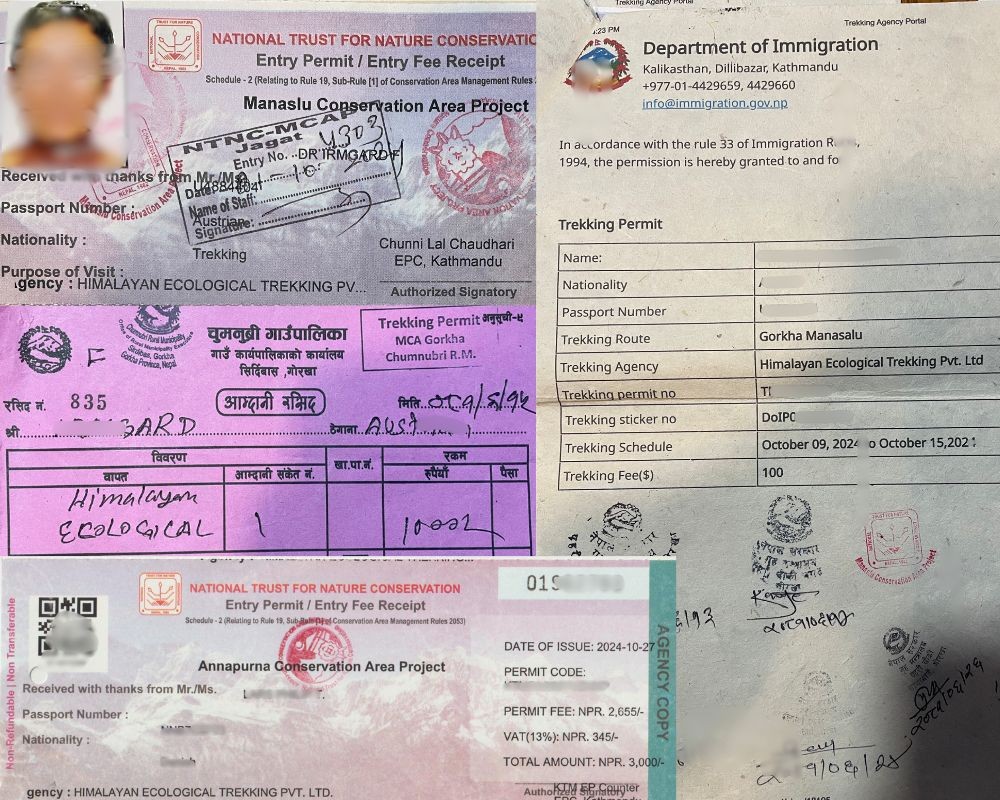
What Are the Current Permit and Fee Rates for the Manaslu Circuit Trek?
The Manaslu Circuit Trek requires the following permits and local fee:
|
Permits / Fees |
Current Rate |
|
Manaslu Restricted Area Permit (RAP) |
|
|
Manaslu Conservation Area Permit (MCAP) |
|
|
Annapurna Conservation Area Permit (ACAP) |
|
|
Chumnubri Rural Municipality Local Fee |
A separate local fee applies. The current amount and collection arrangements will be confirmed before departure. |
Note: Permit fees and local charges can change according to current government regulations. Himalayan Ecological Trekking will confirm the applicable charges and arrange the required permits and fees for your Manaslu Circuit Trek before you enter the trekking route. A TIMS Card is not required for the standard Manaslu Circuit Trek.
Is Travel Insurance Recommended for the Manaslu Circuit Trek?
Yes. Travel insurance is strongly recommended for the Manaslu Circuit Trek. The route reaches 5,106 m, travels through a remote mountain environment and includes sections where medical services and transport can be limited. Suitable insurance provides financial protection if you require medical treatment, emergency evacuation or other covered assistance during the trek.
What Should Your Travel Insurance Cover for the Manaslu Circuit Trek?
Your policy should cover the full duration of your trip and specifically allow trekking at or above the maximum altitude of your itinerary.
It is advisable to choose a policy that includes:
- High-altitude trekking
- Emergency medical treatment
- Emergency rescue and evacuation
- Helicopter evacuation where covered
- Hospitalization
- Repatriation
- Trip cancellation or interruption where covered
- Travel delays and other eligible disruptions
Before purchasing a policy, check the maximum trekking altitude, exclusions, evacuation conditions and geographical coverage carefully.
What Insurance and Emergency Details Should You Carry for the Manaslu Circuit Trek?
Keep the following information easily accessible:
- Travel insurance policy number
- Emergency assistance telephone number
- Trekking company contact details
- Guide contact details
- Emergency contact at home
- Kathmandu accommodation contact details, where applicable
Store the information on your phone and keep a written backup where practical.
Himalayan Ecological Trekking can assist with emergency evacuation coordination when required, but the cost of treatment or evacuation depends on your insurance coverage and the terms of your policy.
Altitude, Acclimatization, Health and Trekking Safety for the Manaslu Circuit Trek
The Manaslu Circuit Trek reaches 5,106 m at Larkya La Pass, making altitude an important consideration throughout the upper section of the itinerary. People respond differently to altitude, and even experienced trekkers can develop symptoms after ascending to higher elevations. The itinerary includes a dedicated acclimatization day at Samagaon, allowing you to spend additional time at elevation before continuing towards Samdo and Dharamsala.
How Does Altitude Affect the Manaslu Circuit Trek?
As you gain elevation, atmospheric pressure decreases and less oxygen is available to the body. You may notice that uphill walking becomes harder, breathing becomes faster and normal activities require more effort.
Altitude illness can affect people who are otherwise fit and healthy. The rate of ascent, sleeping elevation and individual response all influence the risk, so symptoms should always be taken seriously.
Is Acclimatization Necessary for the Manaslu Circuit Trek?
Yes, acclimatization is important. The itinerary includes a dedicated acclimatization day at Samagaon, before continuing towards the higher elevations of Samdo and Dharamsala.
The itinerary follows:
Samagaon → Birendra Lake → Manaslu Base Camp → Samagaon
This allows you to spend several hours at a higher elevation while returning to the same overnight altitude rather than immediately sleeping much higher.
Why Is the Samagaon Acclimatization Day Important on the Manaslu Circuit Trek?
The acclimatization day provides more time for your body to adjust before the itinerary continues to Samdo at 3,875 m and Dharamsala at 4,460 m.
It also combines acclimatization with a scenic mountain hike. The walk towards Birendra Lake and Manaslu Base Camp allows you to experience higher terrain around Mount Manaslu while returning to Samagaon to sleep.
What Are the Symptoms of Altitude Sickness During the Manaslu Circuit Trek?
Common symptoms of acute mountain sickness (AMS) include:
- Headache
- Nausea
- Loss of appetite
- Dizziness
- Unusual tiredness or weakness
- Difficulty sleeping
- Vomiting in some cases
More serious symptoms such as confusion, difficulty walking normally, severe breathlessness or a worsening condition require urgent medical attention.
What Should You Do If You Develop Altitude Sickness During the Manaslu Circuit Trek?
Tell your guide as soon as you feel unwell. Do not hide symptoms or continue ascending simply to stay on schedule. Early communication allows your condition to be assessed and the appropriate response to be considered.
If symptoms are mild, you may need to stop gaining altitude, rest and be monitored. If symptoms worsen, do not improve with rest or include signs of serious altitude illness, descent to a lower elevation and medical attention may be necessary. Completing the planned itinerary should never take priority over your health and safety.
How Can You Reduce the Risk of Altitude Illness on the Manaslu Circuit Trek?
There is no way to guarantee that altitude illness will not occur, but sensible trekking practices can help reduce unnecessary risk:
- Ascend gradually and follow the planned itinerary.
- Use the Samagaon acclimatization day for rest and acclimatization.
- Do not continue to a higher sleeping altitude if you are experiencing symptoms of altitude illness.
- Maintain a comfortable and steady walking pace.
- Eat regular, nutritious meals.
- Drink enough fluid to stay adequately hydrated without forcing excessive amounts.
- Avoid excessive alcohol while acclimatizing.
- Get adequate rest and sleep.
- Tell your guide promptly if you develop any symptoms or feel unusually unwell.
Individual susceptibility varies, so previous high-altitude trekking experience does not guarantee the same response on every trek. Taking symptoms seriously and communicating them early is important, particularly as medical access becomes more limited in the higher sections of the Manaslu Circuit.
How Does a Guide Monitor Trekking Safety on the Manaslu Circuit Trek?
A guide monitors the group throughout the Manaslu Circuit Trek, paying particular attention to altitude, weather, trail conditions, walking pace and each trekker’s wellbeing. If conditions change or someone is struggling, the guide can adjust the pace, rest periods or daily plan as appropriate.
- Monitors trekker condition: The guide observes walking pace, energy levels, response to altitude and general wellbeing during the trek.
- Watches for altitude symptoms: At higher elevations, the guide looks for signs such as headache, dizziness, nausea, unusual tiredness or difficulty walking and can advise on the appropriate response.
- Assesses trail conditions: The guide monitors weather, snow, ice, slippery sections and other trail conditions that may affect the safety or pace of the day's walk.
- Adjusts the pace: When necessary, the guide can slow the walking pace, allow additional rest breaks or recommend a more gradual approach.
- Responds to problems: If a trekker becomes unwell or conditions deteriorate, the guide can adjust the day's plan and coordinate appropriate assistance or emergency support when required.
- Encourages communication: Trekkers should tell the guide promptly if they feel unwell, unusually tired or notice any symptoms. Early communication gives the guide a better opportunity to assess the situation and respond appropriately.
What Should You Know About Medical Access in the Remote Manaslu Region?
Medical access is more limited in the upper Manaslu region than in Kathmandu and larger towns. The trekking route passes through small mountain settlements, and access to medical facilities becomes more limited as you travel higher, particularly around Samdo and Dharamsala (Larkya Phedi).
Trekkers should have suitable travel insurance covering high-altitude trekking and emergency evacuation, carry any necessary personal medication and inform the guide promptly about significant health concerns. At Himalayan Ecological Trekking, our guides monitor trekkers throughout the route and can coordinate appropriate assistance or emergency support when required. In remote sections, medical treatment or evacuation can take time, so taking symptoms seriously and seeking help early is important.
What Happens in a Serious Emergency During the Manaslu Circuit Trek?
In a serious emergency, the priority is to assess the situation, prevent further deterioration and move the affected trekker to a safer or lower elevation when appropriate. The guide will consider the trekker’s condition, altitude, weather, trail conditions and available access before deciding on the most suitable response. For suspected serious altitude illness, descent and medical attention should take priority over continuing the planned route.
Depending on the location and circumstances, the response may involve local assistance, road transport, medical treatment or evacuation, including helicopter evacuation where feasible. Himalayan Ecological Trekking coordinates with the guide and relevant local services to arrange appropriate assistance and emergency support when required. Trekkers must have travel insurance that covers high-altitude trekking, emergency medical treatment and evacuation, as the cost of rescue and medical services is not included in the standard trek package.
Guides, Porters and Baggage Arrangements for the Manaslu Circuit Trek
The Manaslu Circuit Trek is supported by a professional trekking guide, with porter service available as an optional add-on unless specifically included in your booking. The guide manages route navigation, daily trekking arrangements and communication along the trail, while porters can carry the main trekking luggage so that trekkers can walk with a lighter daypack.
Is a Guide Required for the Manaslu Circuit Trek?
Yes. A licensed trekking guide is required for the Manaslu Circuit Trek because the route enters the Manaslu restricted area. The required restricted-area trekking permit must be arranged through a registered trekking agency, so independent trekking is not permitted on this route.
With Himalayan Ecological Trekking, a government-licensed English-speaking guide accompanies the group throughout the trek. The guide assists with route navigation, daily trekking arrangements, altitude awareness and communication with local services when needed. An assistant guide is provided for groups of more than 10 trekkers.
Is a Guide Included in the Manaslu Circuit Trek?
Yes. The Manaslu Circuit Trek includes a government-licensed, English-speaking trekking guide who is trained in first aid and experienced in mountain trekking.
During the trek, your guide provides practical support with:
- Route navigation
- Daily walking arrangements
- Teahouse coordination
- Communication with local communities and lodges
- Walking pace and rest breaks
- Practical support on the trail
- General trekking safety
- Assistance with unexpected situations
For groups of more than 10 trekkers, an assistant guide is provided where applicable to support the group and help manage the trek effectively.
Is Porter Service Included in the Manaslu Circuit Trek?
Porter service is not included in the standard Manaslu Circuit Trek package, but it can be added as an optional service. Himalayan Ecological Trekking can arrange one porter for every two trekkers, with a combined luggage limit of 20 kg (10 kg per trekker).
The porter carries the main trekking luggage between overnight stops, while you carry a lighter daypack with the items needed during the day's walk. Porter service should be arranged before the trek so the necessary support can be organized for the group.
How Much Can a Porter Carry on the Manaslu Circuit Trek?
Under the standard Himalayan Ecological Trekking porter arrangement, one porter is provided for every two trekkers. The porter service is not included in the standard Manaslu Circuit Trek package and can be arranged as an add-on.
The maximum combined load is:
20 kg for two trekkers, or approximately 10 kg per trekker.
Trekkers should keep their luggage within the agreed weight limit and carry essential personal items, valuables, documents and medication in their own daypack. Himalayan Ecological Trekking can arrange the porter service before the trek when requested, subject to the applicable additional charge.
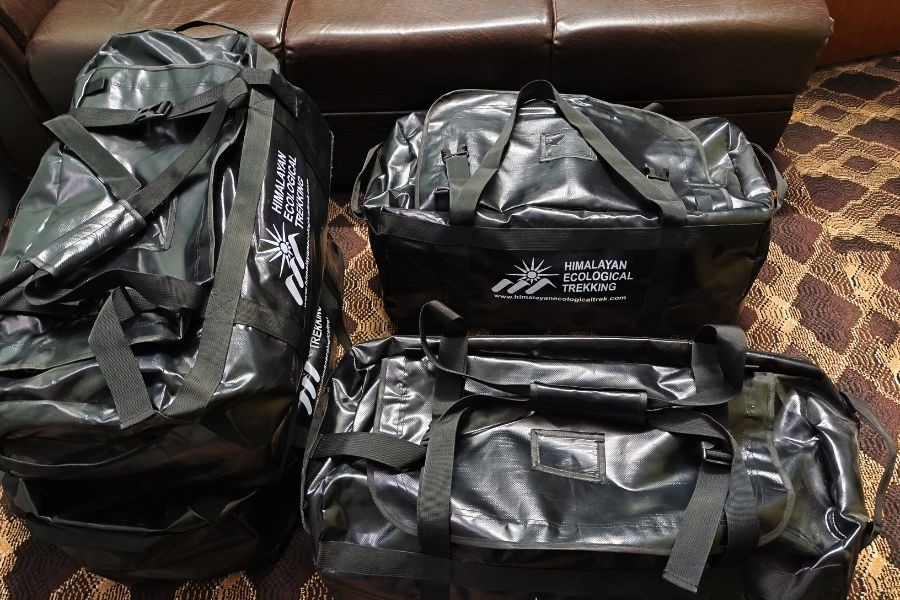
What Should You Carry in Your Daypack on the Manaslu Circuit Trek?
Your daypack should contain the items you may need while walking, rather than your entire trekking luggage.
Useful items include:
- Water bottle or hydration system
- Snacks
- Warm layer
- Waterproof jacket
- Hat and gloves
- Sunglasses
- Sunscreen and lip balm
- Headtorch
- Mobile phone and power bank
- Personal medication
- Passport and important documents
- Camera or other personal items
Keep your daypack comfortable and reasonably light because you will carry it throughout each walking day.
How Is Your Main Trekking Luggage Transported on the Manaslu Circuit Trek?
Porter service is not included in the standard Manaslu Circuit Trek package, but it can be added if you prefer to walk with a lighter daypack. When porter service is arranged, your main luggage is carried between overnight stops, while you carry a daypack with the items you need during the day. This can make longer or steeper sections of the route more comfortable.
Himalayan Ecological Trekking provides a waterproof duffle bag for the trek, whether or not you use porter service. The duffle bag is used for your main trekking luggage, while the optional porter service covers carrying it between overnight stops. When a porter is arranged, the allowance is 20 kg for two trekkers, with a maximum of 10 kg per trekker.
Keep valuables, travel documents, medication, water and other essential personal items in your own daypack so they remain with you during the trek.
Is the Manaslu Circuit Trek Suitable for Solo Trekkers and Groups?
The Manaslu Circuit Trek is designed for groups of 1 to 20 people, so it can be arranged for solo travelers, couples, families and larger private groups.
As the Manaslu Circuit is a regulated trekking route, solo travelers need to have the required guide, agency and permit arrangements confirmed before starting the trek. The same arrangements can be organized for private groups according to their group size and trekking requirements.
Money, Payments and Personal Expenses on the Manaslu Circuit Trek
The Manaslu Circuit Trek is an organized teahouse trek, so the main trekking services are arranged as part of your package according to the stated inclusions. Personal spending is generally for drinks, snacks, showers, charging, Wi-Fi, tips and other optional purchases.
Because the route passes through remote mountain villages, it is important to arrange enough Nepalese cash in Kathmandu before starting the trek.
How Much Money Should You Carry for the Manaslu Circuit Trek?
For a standard organized trek, carrying around NPR 15,000–20,000 in Nepalese cash is a practical starting amount for personal expenses. The amount you need will depend on your spending habits and how many additional services you use along the route.
This can cover additional drinks, snacks, hot showers, charging, occasional Wi-Fi and other minor purchases. Carry some extra reserve if you plan to buy souvenirs, purchase more drinks or need to manage an unexpected personal expense.
Where Should You Get Nepalese Rupees Before the Manaslu Circuit Trek?
It is best to arrange your Nepalese rupees in Kathmandu before travelling to Machha Khola, as cash access becomes more limited once you are on the trekking route. ATMs and reliable money exchange facilities are not consistently available in the remote Manaslu region.
You can exchange or withdraw money through banks, licensed money exchanges and established ATM services in Kathmandu. Carry a mix of larger and smaller notes, as smaller denominations are more convenient for drinks, snacks, hot showers, charging and other minor expenses in mountain villages.
Are There ATMs Along the Manaslu Circuit Trek?
You should not rely on ATMs during the Manaslu Circuit Trek. ATM access is not dependable along the trekking route, particularly in the remote upper sections beyond the larger settlements.
It is best to withdraw and carry enough Nepalese cash before leaving Kathmandu to cover your expected personal expenses, with some extra reserve for unexpected costs. This avoids depending on ATM facilities when you are already on the trail.
Can You Pay by Card During the Manaslu Circuit Trek?
Cash is the main payment method on the Manaslu Circuit Trek. Card payments are not widely available in the remote mountain villages, and trekkers should not rely on Visa, MasterCard or other cards for everyday purchases at teahouses and small local businesses.
Card payment facilities are more commonly available in Kathmandu and larger towns, but once you are on the trekking route, it is best to carry enough Nepalese cash for personal expenses such as drinks, snacks, showers, charging and other additional services.
What Personal Expenses Should You Budget For During the Manaslu Circuit Trek?
Although the package covers the agreed trekking services, you may need extra cash for personal purchases and optional services during the trek. Common expenses include:
|
Personal Expense |
Typical Use |
|
Tea, coffee and hot drinks |
Purchased at teahouses |
|
Bottled or additional water |
Depending on your water arrangements |
|
Snacks |
During trekking days |
|
Hot showers |
Where available |
|
Wi-Fi |
Where available |
|
Device charging |
At selected teahouses |
|
Mobile data and phone calls |
Where network service is available |
|
Tips |
For your guide, porter and other trekking staff |
|
Souvenirs |
In villages or Kathmandu |
|
Unexpected personal expenses |
As required |
Note: Availability and prices vary between villages and teahouses, particularly in the more remote sections of the Manaslu Circuit.
Are Tips Included in the Manaslu Circuit Trek Cost?
Tips are not included in the Manaslu Circuit Trek package cost and are normally given separately at the end of the trek. Tipping is not mandatory, but it is a customary way to thank your guide, porter and other trekking staff for their support.
There is no fixed amount you are required to tip. You can decide what feels appropriate based on the length of the trek, the service you received and the support provided by the trekking staff. If travelling as a group, tips can also be collected and shared among the staff.
How Can You Manage Your Money During the Manaslu Circuit Trek?
It is best to arrange enough Nepalese rupees in Kathmandu before starting the Manaslu Circuit Trek. Carry your trek budget in cash and keep a separate amount as an emergency reserve so that you are not left without funds if your expenses are higher than expected.
ATM access and card payments are limited and may not be reliable in remote parts of the route. Carry enough cash from the start for meals or drinks not covered by the package, showers, charging, Wi-Fi, snacks, tips and other personal expenses. Keep your money secure and divided between more than one place in your trekking bag.
Himalayan Culture, Buddhist Heritage and Local Communities on the Manaslu Circuit Trek
The Manaslu Circuit Trek is not only a high-altitude mountain journey but also a trek through communities with strong Himalayan and Tibetan Buddhist traditions. As the trail climbs from the lower Budhi Gandaki Valley into the higher villages of Namrung, Lho, Shyala, Samagaon and Samdo, traditional houses, monasteries, mani walls, chortens, prayer flags and other religious features become an increasingly visible part of the landscape.
The region includes communities with Gurung traditions and strong Tibetan cultural influence, particularly in the upper valleys. Local livelihoods have traditionally depended on agriculture, livestock and trade, while tourism now provides additional income through teahouses, local services, guides, porters and transport.
What Is the Manaslu Region Known For on the Manaslu Circuit Trek?
The Manaslu region is known for its dramatic mountain scenery, remote Himalayan villages and strong Tibetan Buddhist influence. The Manaslu Circuit passes through the Budhi Gandaki and Nubri valleys, where trekkers encounter forests, rocky mountain valleys, high pastures, monasteries, chortens, mani walls and traditional settlements.
The upper section of the route has a more remote mountain character, particularly around Samagaon, Samdo and Dharamsala. Along the way, trekkers can see how local communities have adapted to life at high altitude through traditional farming, livestock keeping, trade and tourism while travelling through some of the region's most striking Himalayan landscapes.
Which Communities Can You Experience on the Manaslu Circuit Trek?
The Manaslu Circuit Trek passes through mountain communities shaped by Gurung, Tamang, Tibetan-influenced and other Himalayan traditions. The cultural character changes gradually as you move from the lower Budhi Gandaki Valley towards the higher mountain settlements.
In the higher villages, including Lho, Shyala, Samagaon and Samdo, Tibetan Buddhist influences become more visible in the architecture, monasteries and gompas, chortens, mani walls, prayer flags and local customs.
What Is Distinctive About Buddhist Culture in the Manaslu Region?
Buddhist traditions are an important part of everyday life in the upper Manaslu region, particularly in villages influenced by Tibetan Buddhist culture. Trekkers encounter these traditions not only at monasteries and other religious sites but also through the way villages, homes and trails are arranged.
Along the route, you may see mani walls, chortens, prayer flags, prayer wheels, monasteries and small shrines. These are part of the local cultural landscape and are often found alongside homes, fields and trekking trails. The combination of Buddhist traditions, mountain settlements and long-established village practices gives the upper Manaslu route a distinct cultural character.
What Can You Experience in Traditional Villages During the Manaslu Circuit Trek?
The Manaslu Circuit Trek passes through traditional mountain villages such as Namrung, Lho, Shyala, Samagaon, Samdo, Dharamsala and Bimthang. Along the way, you can see stone-built houses, cultivated fields, monasteries and gompas, mani walls, prayer flags and other features of everyday life in the Manaslu region.
The character of the villages changes as the trail gains altitude. Lower settlements generally have more vegetation, farmland and forest, while the upper villages become colder, more open and more sparsely populated. Spending time in these settlements also gives you a chance to observe how local communities have adapted their homes, farming and daily activities to the changing mountain environment.
What Can You See at Pungyen Gompa on the Manaslu Circuit Trek?
Pungyen Gompa, at approximately 4,000 m, is reached on the route from Shyala to Samagaon. The visit adds a cultural element to this section of the Manaslu Circuit, with the gompa set among the high mountain surroundings of the upper Manaslu region.
From the gompa, trekkers can enjoy the peaceful setting and surrounding mountain views before continuing towards Samagaon. As it is a religious site, visitors should keep noise to a minimum, respect local customs and follow any guidance given when entering the gompa or nearby prayer areas.
What Can You Experience Around Samagaon and Samdo on the Manaslu Circuit Trek?
Samagaon is one of the main settlements in the upper Manaslu region and offers an opportunity to experience the culture and daily life of the Nubri Valley. Traditional stone houses, monasteries, mani walls, prayer flags and surrounding mountain views create a distinctly Himalayan setting. The village is also the base for the hike towards Birendra Lake and Manaslu Base Camp, allowing trekkers to explore beyond the main settlement during the acclimatisation day.
Samdo is smaller and more remote, with a quieter atmosphere and traditional stone-built homes surrounded by open mountain terrain. Its high-altitude setting gives a clearer sense of how local communities have adapted their homes, livestock and daily routines to the demanding Himalayan environment. Spending time in both villages provides a contrast between the more established settlement of Samagaon and the isolated character of Samdo before the trail reaches the higher section towards Dharamsala (Larkya Phedi).
What Buddhist Features Can You See Along the Manaslu Circuit Trek?
Buddhist religious features become more noticeable as the trail reaches the upper Manaslu villages, reflecting the strong Tibetan Buddhist influence of the region. Along the route, trekkers may see:
- Mani walls with carved Buddhist prayer stones
- Chortens and small roadside stupas
- Prayer flags placed around villages, trails and religious sites
- Prayer wheels beside paths and monasteries
- Monasteries and gompas used for religious practice and community life
- Shrines and other religious structures located in and around the villages
These are active parts of the local religious landscape rather than simply sights along the trekking route. Walk around religious structures respectfully, avoid disturbing prayer objects or stones, and follow local guidance when entering a gompa, monastery or shrine.
What Should You Know About Buddhist and Village Etiquette on the Manaslu Circuit Trek?
The Manaslu Circuit passes through villages where Tibetan Buddhist traditions remain an important part of daily life, particularly in the upper sections of the route. When visiting monasteries, gompas, shrines and other religious places:
- Dress respectfully and avoid clothing that may be considered inappropriate for a religious setting.
- Keep your voice low and avoid disturbing prayers or religious activities.
- Follow instructions from monks, local residents and your guide.
- Ask permission before entering restricted, private or enclosed areas.
- Do not touch, move or handle religious objects unless invited to do so.
- Do not step over religious objects, mani stones or other sacred items.
- Walk clockwise around mani walls, chortens and prayer wheels where this follows local practice.
- Do not sit on, climb over or lean against religious structures.
- Ask before taking photographs of people, ceremonies or religious activities.
In villages, respect local privacy and daily routines. Ask before entering private homes or taking photographs of residents, avoid unnecessary disturbance and follow local customs when interacting with people. A considerate approach allows you to visit religious sites and communities respectfully while avoiding interference with local life.
Can I Photograph Local People, Monks and Religious Sites During the Manaslu Circuit Trek?
Photography is welcome in many parts of the Manaslu Circuit Trek, but ask permission before photographing local people, monks or children, particularly for close-up portraits. Be considerate when people are working, resting, eating or carrying out their daily activities, and respect their decision if they prefer not to be photographed.
Photography rules can vary between gompas, monasteries and other religious sites. Look for signs or ask locally before taking photographs, and do not use flash where it may disturb others. During prayers, ceremonies or other religious activities, avoid photographing if requested and keep a respectful distance so that worshippers are not disturbed.
Nature, Environment and Responsible Trekking on the Manaslu Circuit Trek
The Manaslu Circuit Trek Days passes through a wide range of mountain environments, beginning in the river valleys of the lower Budhi Gandaki area and continuing through forests, terraced hillsides, traditional settlements and increasingly open alpine terrain around Samagaon, Samdo, Dharamsala and Larkya La. The Manaslu Conservation Area is part of this wider natural landscape, supporting forests, mountain habitats, wildlife and plant diversity.
What Natural Landscapes Can You See on the Manaslu Circuit Trek?
The landscape changes gradually as the trek gains elevation:
Budhi Gandaki river valleys → forests → terraced hillsides → mountain settlements → alpine terrain
Lower sections around Machha Khola and Jagat include river valleys, steep hills and forested slopes. As you move towards Namrung, Lho, Shyala and Samagaon, the landscape becomes more mountainous, with traditional settlements, cultivated land and larger views of the surrounding peaks.
Around Samdo, Dharamsala and Larkya La, vegetation becomes more limited and the surroundings become increasingly open, rocky and exposed.
What Forests, Plants and Wildlife Can You Encounter on the Manaslu Circuit Trek?
The Manaslu Circuit Trek passes through several vegetation zones as the altitude increases. Lower sections of the trail include forests and cultivated hillsides, with areas of rhododendron and other mountain vegetation. As the route climbs towards Namrung, Lho, Shyala and Samagaon, the landscape becomes more open, with fewer trees and more alpine vegetation, rocky terrain and exposed mountain slopes.
The Manaslu region is also home to Himalayan birds and wildlife, although sightings depend on the season, location and conditions and are never guaranteed. Trekkers may notice birds and other animals along quieter sections of the trail. If you encounter wildlife, observe quietly from a safe distance and do not feed, chase, handle or deliberately approach animals or their young.
How Can You Protect the Manaslu Circuit Trail During the Trek?
Responsible trekking helps protect the Manaslu Circuit for local communities, future trekkers and the natural environment. The trail passes through forests, farmland, grazing areas and fragile mountain terrain, so small choices can help reduce vegetation damage, soil erosion and disturbance to local land.
- Stay on the marked route: Avoid shortcuts through vegetation, farmland, pasture or fragile ground, even when they seem quicker.
- Respect farmland and grazing areas: Do not walk through crops or disturb areas used for livestock. Follow existing paths when the trail passes through cultivated or grazing land.
- Protect stone walls and local structures: Avoid climbing over or moving traditional stone walls, trail markers or other local structures.
- Help prevent erosion: Do not widen the trail or create new routes around muddy, steep or difficult sections. Repeated off-trail walking can damage vegetation and loosen the soil.
- Follow local guidance: When the route passes through private farmland, grazing areas or culturally important places, follow the advice of your guide and local residents.
How Can You Reduce Plastic Waste and Manage Rubbish on the Manaslu Circuit Trek?
Carry a reusable water bottle or hydration system and refill it with treated, filtered or boiled water where available instead of relying on single-use plastic bottles. The Manaslu Circuit Trek package includes water purification tablets, making it easier to refill safely during the trek. Avoid unnecessary packaging and choose reusable items where practical.
Waste collection and disposal facilities can be limited in remote villages, so keep food wrappers, tissues, plastic packaging and other personal rubbish with you until you reach your accommodation or a suitable disposal point. Never leave rubbish along the trail, in forests, pasture or near water sources, and do not burn or bury plastic or other non-biodegradable waste. Carrying a small waste bag is a simple way to keep personal rubbish contained until it can be disposed of properly.
How Can You Protect Streams, Springs and Other Natural Water Sources During the Manaslu Circuit Trek?
Water from streams, springs and local water sources is important to communities and wildlife along the Manaslu route. Trekkers can help protect these sources by keeping them free from soap, shampoo, detergents and other contaminants.
Avoid washing yourself, clothes or dishes directly in natural water sources. Use designated washing areas where available, and use only the water you need at teahouses. Avoid unnecessary wastage, especially in remote villages where water may need to be collected, carried or managed carefully.
How Can You Avoid Damaging Vegetation and Natural Features During the Manaslu Circuit Trek?
Help protect the natural environment by staying on established trails and leaving plants, trees, rocks and other natural features where you find them. Avoid:
- Picking wildflowers or other plants
- Cutting branches or damaging trees
- Removing stones, rocks or other natural features
- Carving names or messages into trees, rocks or buildings
- Taking natural objects as souvenirs
- Creating shortcuts or new trails
- Disturbing wildlife, nesting sites or other sensitive areas
The Manaslu Circuit passes through forests, mountain valleys, riversides and high-altitude landscapes that are part of the local environment. Leave the landscape as you found it so that its natural character is protected for local communities, wildlife and future trekkers.
How Can You Support Local Communities Through Responsible Travel During the Manaslu Circuit Trek?
The Manaslu Circuit Trek passes through rural mountain communities where tourism supports teahouses, local shops, guides, porters, transport providers and other small businesses. Spending locally when practical helps direct part of your trekking expenditure towards the communities along the route.
Choose locally operated accommodation and services where available, buy locally made or available products, and pay agreed prices fairly. Treat local people and trekking staff with respect, follow local customs, avoid unnecessary waste and take your rubbish with you when suitable disposal facilities are not available. These simple practices help reduce the impact of trekking while supporting the communities that welcome visitors along the Manaslu route.
How Does Himalayan Ecological Trekking Support Responsible Travel on the Manaslu Circuit Trek – 12 Days?
Himalayan Ecological Trekking has been organising trekking and travel experiences in Nepal since 1995. On the Manaslu Circuit Trek, we promote responsible travel through the way we work with local guides, porters, teahouses, transport providers and other service partners. We encourage travellers to respect local communities and culture while taking practical steps to reduce their impact on the mountain environment.
Our responsible-travel practices on the Manaslu Circuit include:
- Supporting local employment and services: We work with local guides, porters, teahouses, transport providers and other local businesses where appropriate, helping keep trekking-related spending within communities along the route.
- Reducing waste: We encourage trekkers to carry reusable water bottles, avoid unnecessary packaging and take personal waste to appropriate disposal points rather than leaving it on the trail.
- Protecting the natural environment: We encourage travellers to stay on established trails, avoid damaging vegetation and natural features, and avoid disturbing wildlife.
- Using local resources carefully: Water, firewood, electricity and other resources can be limited in remote mountain communities. Trekkers are encouraged to use them thoughtfully and avoid unnecessary consumption.
- Respecting local communities and culture: We ask trekkers to respect village customs, religious sites, local traditions, private property and everyday community life throughout the trek.
- Corporate Social Responsibility: Himalayan Ecological Trekking supports Corporate Social Responsibility (CSR) initiatives in Nepal through practical, community-focused contributions intended to support local people and the communities where we operate.
Through these practices, we aim to conduct the Manaslu Circuit Trek in a way that respects the people, culture and natural environment of the region while providing trekkers with a responsible way to experience the route.
What Should You Avoid on the Manaslu Circuit Trek and Why Does Responsible Trekking Matter?
The Manaslu Circuit Trek passes through river valleys, forests, farmland, pastures, traditional villages and high alpine landscapes. Parts of the route are remote, with limited waste facilities and other local resources. Simple, responsible behavior helps reduce unnecessary pressure on the environment and shows respect for the people, culture and places you encounter along the trail.
During the Manaslu Circuit Trek, avoid the following:
- Leaving rubbish along the trail: Keep personal waste with you and dispose of it at suitable collection points or at your accommodation.
- Using unnecessary single-use plastic: Carry a reusable water bottle and avoid disposable packaging where practical.
- Walking outside established trails: Stay on the marked route to protect vegetation and prevent unnecessary erosion.
- Disturbing wildlife: Watch animals from a safe distance and never feed, chase or try to touch them.
- Taking natural materials: Leave plants, flowers, rocks and other natural features where you find them.
- Entering farmland or private property without permission: Stay on public paths and respect cultivated land and local livelihoods.
- Approaching livestock too closely: Give yaks, cattle, horses, mules and other animals enough space, especially on narrow trails.
- Making excessive noise: Keep voices and music low around villages, monasteries, gompas and quieter natural areas.
- Wasting water and other local resources: Use water carefully, particularly in higher and more remote sections where supplies may be limited.
- Disrespecting cultural and religious places: Follow local customs when visiting monasteries, gompas, chortens, prayer walls and other religious sites.
Responsible trekking does not require complicated measures. Carrying your rubbish, staying on established trails, conserving water, giving livestock and wildlife enough space, and following local customs are practical steps every trekker can take. These habits help protect the Manaslu Circuit Trek route while supporting respectful interaction with the communities and cultural sites along the way.
Booking and Payment for the Manaslu Circuit Trek
Booking the Manaslu Circuit Trek requires your preferred trekking date, number of trekkers and any additional services you may need.
Himalayan Ecological Trekking will confirm the trekking arrangements, cost and availability before you make the payment. Any requested add-ons will also be confirmed in advance, so you know what is included in your package and what will cost extra.
Can I Book a Private or Group Manaslu Circuit Trek?
Yes. Himalayan Ecological Trekking can arrange the Manaslu Circuit Trek as a private trek or for groups, depending on your travel dates and preferred arrangements.
A private trek provides greater flexibility over the departure date, walking pace and daily arrangements. Group departures are suitable for travelers who prefer to trek with other participants.
Can the Manaslu Circuit Trek Be Customized?
Yes. The Manaslu Circuit Trek can be customized where practical according to your travel dates, group size, walking pace and service preferences.
Depending on availability, HET can arrange additional services such as porter service, extra nights in Kathmandu, private transport or changes to the standard itinerary. Private groups can also discuss additional trekking days or arrangements for guides, porters and accommodation before departure.
Can I Book the Manaslu Circuit Trek at the Last Minute?
Yes. Last-minute bookings may be possible, depending on the availability of accommodation, transport, guides, porters and other services required for your trekking dates.
For a last-minute booking, please provide:
- Preferred trekking date
- Number of trekkers
- Nationality
- Private or group trekking preference
- Hotel name and location in Kathmandu
- Any additional services or special requirements
Availability can be more limited during the main trekking seasons, particularly spring and autumn, when transport and accommodation may be in higher demand.
Our team will check the arrangements required for your chosen date and confirm whether the Manaslu Circuit Trek can be organized. For last-minute departures, some services may need to be confirmed close to the trek departure date.
How Do You Book the Manaslu Circuit Trek?
Booking the Manaslu Circuit Trek is straightforward. First, tell us your preferred trekking dates, group size and any additional services you need. Our team will then confirm the itinerary, cost and arrangements for your trek.
1. Send Your Trek Enquiry
Please provide the following details:
- Preferred trekking dates
- Number of trekkers
- Nationality
- Preferred trekking arrangements
- Any special requirements
You can also tell us whether you need additional services such as porter service, private transport and extra nights in Kathmandu or additional accommodation.
2. Confirm the Itinerary and Cost
We will confirm the Manaslu Circuit Trek itinerary, accommodation, transport and included services based on your travel dates and group size.
For private or customized departures, the final cost may vary depending on the group size, changes to the itinerary and any additional services you request.
3. Provide Your Booking Details
Once you decide to book, we will ask for the traveller information needed to arrange permits, accommodation, transport and other trekking services.
Please provide accurate information and make sure the details match your travel documents where applicable.
4. Make Your Payment
Himalayan Ecological Trekking accepts payment by credit card or SWIFT/wire transfer. A 4% processing fee applies to credit card payments.
For wire transfers, any bank, transfer or payment service charges are the responsibility of the traveller. Please ensure that the full agreed amount is received in our company account after any applicable charges.
How to Pay by Credit Card
You can make your payment through our secure online payment page. Enter the required details and follow the payment instructions.
Make a Secure Credit Card Payment
How to Pay by SWIFT / Wire Transfer
You can also pay directly to our company bank account using the following details:
|
Bank Details |
Information |
|
Account Name |
Himalayan Ecological Trekking Pvt. Ltd. |
|
Account Number |
12000076670027 |
|
Bank Name |
Himalayan Bank Ltd. |
|
Account Type |
Foreign Currency (USD) |
|
Branch |
Hiti Durbar |
|
Bank Address |
Tridevi Marg, Thamel, Kathmandu, Nepal |
|
SWIFT Code |
HIMANPKA |
Note: Any bank, transfer or payment service charges related to the payment are the responsibility of the traveller. Please ensure that the full agreed payment amount is received in the company account after any applicable fees.
5. Receive Your Booking Confirmation
After we receive the required payment and traveller details, we will confirm your Manaslu Circuit Trek booking and complete the necessary arrangements.
Before your trek, we will provide the confirmed details for your arrival in Kathmandu, trekking schedule, transport, accommodation and other booked services.
How to Make a Booking
To book your trip, simply find and click on the “Customise Your Trip” button at the top and fill in your preferred travel dates, group size, and any special requests. Once we receive your details, our team will get back to you promptly.
Alternatively, you can click “ReserveNow” to secure your spot directly.
Let us help you plan your perfect Himalayan adventure.
What Makes Your Journey with Us Different?
At Himalayan Ecological Trekking, we believe tourism should be a force for good, and that takes responsibility for the land and its people. Beyond the breathtaking views, your trip supports our mission of Responsible Tourism. For over 25 years, we have reinvested in the remote regions we explore, ensuring your journey supports the land and its people. We take great pride in our long-standing history of community support in Nepal. We have transformed rural education by developing 7 regional schools. Beyond the classroom, we bring vital healthcare to remote hill areas and empower the trekking community through Porter's Progress, an initiative dedicated to providing porters with the gear they need for the trail.
-
Proven Commitment: Since 2009, we have built and restored multiple earthquake-resistant schools in rural regions like Dhading and Sindhupalchowk.
-
A Commitment to Sustainability: We are among the few operators with a formal, transparent Sustainability Policy. We don't just follow procedures; we set standards for socially and environmentally conscious travel.
-
Giving Back: Active logistical and financial support for rural Himalayan villages.
-
Empowering Locals: We prioritise small businesses and regional cultural preservation.
-
Our Goal: To leave the Himalayas exactly as we found them while helping the people who live there thrive.
Learn what your trip contributes to, more about our projects and how we give back →
Manaslu Circuit Trek Route Map
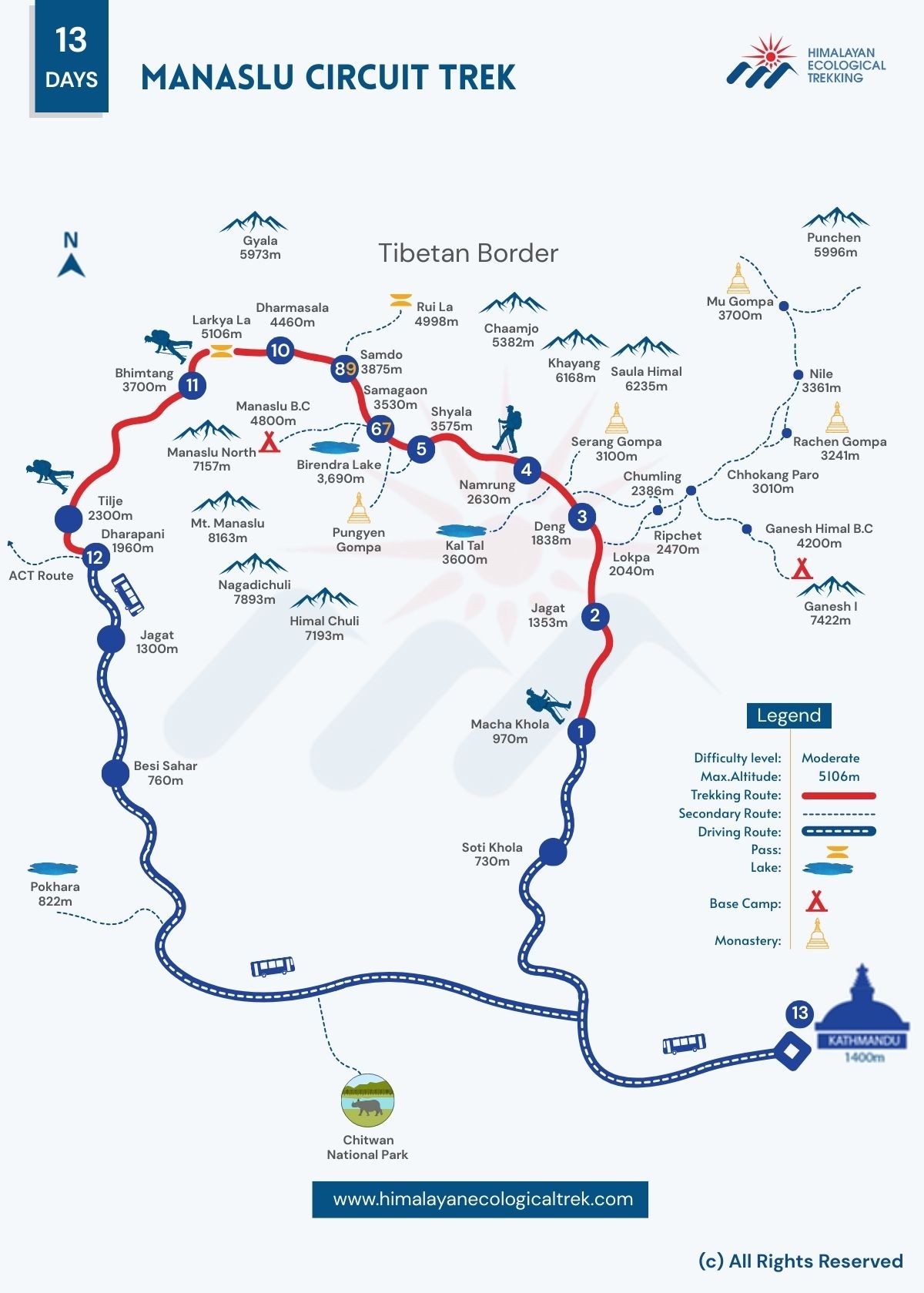
Manaslu Circuit Trek Google Route Map
Manaslu Circuit Trek Elevation / Altitude
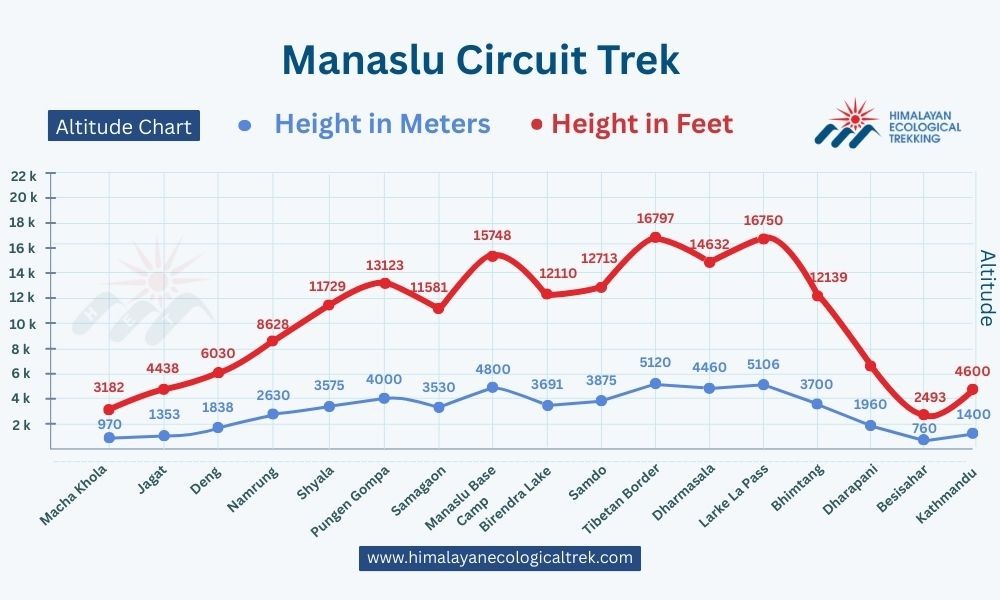
Manaslu Circuit Itinerary Options:
Manaslu Circuit Trek 12 Days
Day 1: Kathmandu/ Drive to Machkhola
Day 2: Machakhola/ Trek to Jagat
Day 3: Jagat/ Deng
Day 4: Deng/Namrung
Day 5: Namrung/ Shyala
Day 6: Shyala/Sama (via Pungyen)
Day 7: Sama Rest (Birendra Lake, Manaslu Base Camp)
Day 8: Sama/ Samdo
Day 9: Samdo/ Dharmasala
Day 10: Dharmasala/Bhimtang (via Larkya La)
Day 11: Bhimtang/Dharapani
Day 12: Dharapani/Drive to Kathmandu or Pokhara
The price is per person, 790 USD for two people
Manaslu Tsum Valley Trek 18 Days
Day 1: Kathmandu/Drive to Machha Khola
Day 2: Machakhola/ Trek to Jagat
Day 3: Jagat/ Lokpa
Day 4: Lokpa/ Chumling
Day 5: Chumling/ Chhokangparo
Day 6: Chhokangparo/ Nile
Day 7: Acclimatisation Day at Nile - Hike to Mu Gompa
Day 8: Nile/ Chuling
Day 9: Chumling/ Deng
Day 10: Deng/ Namrung
Day 11: Namrung/ Shyala
Day 12: Shyala/ Sama Gaon
Day 13: Sama Gaon/ Samdo
Day 14: Acclimatisation day: Side Trip hike to Rui La (Tibetan Border)
Day 15: Samdo/ Dharamshala
Day 16: Dharmasala/ Bhimtang Via Larke-La (5106m/ 16751ft)
Day 17: Bhimtang/ Dharapani
Day 18: Dharapni/ Drive to Kathmandu or Pokhara
Join our group departing on 22 April for the Manslu Tsum Valley 18-days itinerary above. Feel free to drop us message for cost and details. We provide most competitive prices and high-end service.
Manaslu Tsum Valley Hidden Route
Day 1: Kathmandu/ Drive to Machha Khola
Day 2: Machakhola/ Trek to Jagat
Day 3: Jagat/ Lokpa
Day 4: Lokpa/ Ripchet
Day 5: Ripchet/ Gumba Lungdang
Day 8: Day hike to Ganesh Himal Base Camp; Back to Gumba Lungdang
Day 9: Gumba Lungdang/ Lamagaon
Day 10: Rest Day, visit the Monasteries and Milarepa cave
Day 11: Lamagaon/ Mu gumba
Day 12: Visit Chho Syong and Trek to Rachen Gumba
Day 13: Rachen Gumba/ Chumling
Day 14: Chumling to Thorjong
Day 15: Thorjong/ Bihi Phedi (Joined Manaslu Route)
Day 16: Visit the Serang gumba after lunch; then to Prok
Day 17: Day trip to Kal tal (3574m), back to Prok
Day 18: Prok/ Namrung
Day 19: Namrung to Shyala
Day 20: Shyala/ Sama via Pung Gyen Gompa
Day 21: Sama to Samdo via Birendra Lake
Day 22: Rest day, or Hike to Tibetan border or Samdo Peak
Day 23: Samdo/ Dharamsala
Day 24: Dharamsala/ Bhimthang via Larke-pass(5106m)
Day 25: Bhimthang/ Dharapani
Day 26: Dharapani/ Drive to Kathmandu or Pokhara
If the itineraries above don’t quite fit your timeframe and preferences, we can adjust or create one that suits you.
How difficult is the Manaslu trek?
The Manaslu circuit trek is considered moderately difficult. The trail slowly ascends into the mountain areas, and we slowly gain altitude. Some of the walking days may be lengthy, particularly the day when crossing the Larke-La pass is a long day, and you need to be able to walk on rugged, steep terrain.
Can I do a trek without a guide?
Trekking in most of the Manaslu area without a guide is not possible. It is a restricted zone, and as per the law of the Nepal government, a licensed guide and special permit are compulsory for the safety and security of trekkers.
What is the highest point on the Manaslu circuit trek?
At 5160 meters (16929 feet) above sea level, the Larkya La Pass reaches the highest elevation point during the Manaslu Circuit trek. The remarkable panorama of surrounding mountains strikes trekkers at this tricky elevation region because of the demanding mountainous conditions and tall elevations that exceed 5000 meters.
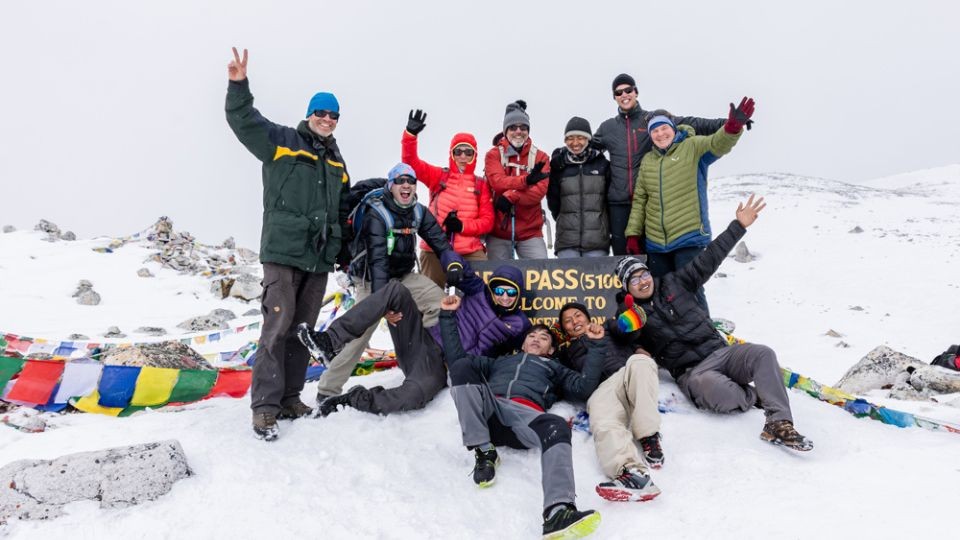
How can I prevent getting altitude sickness?
This is a guided trek, and you will be accompanied by one of Nepal's experienced trekking guides who knows how to recognize altitude sickness (as there may be other physical conditions as well with similar symptoms) and who knows what to do. They will take very good care of you.
In general, you must climb up slowly not much more than 500 meters (altitude of night stay) per day. Drink plenty of water and avoid smoking and drinking liquor. If symptoms of altitude sickness are observed, climb slowly or stop for a rest day (depending on intensity), allowing your body to adjust. If symptoms persist and/or get worse, you must move to a lower altitude to avoid life-threatening conditions.
How are Emergencies Handled?
At HET, your safety is our top priority. Our guides are trained in first aid, altitude awareness, and emergency response, enabling them to act calmly and effectively in any unexpected situation. They maintain regular contact via mobile or satellite communication, ensuring quick coordination of assistance even in remote areas. All field teams are supported by our Kathmandu office, which provides 24/7 backup for logistics, medical guidance, and emergency decision-making.
Prevention is key on all our treks. We conduct daily health check-ins, build acclimatisation days into our itineraries, and provide clear guidance on hydration, nutrition, and pacing. For minor problems, our team offers immediate first aid on the trail. For mild altitude sickness, trekkers receive rest, fluids, and medication such as acetazolamide if prescribed. If symptoms continue or intensify, the safest and most effective approach is to descend to a lower altitude, which typically eases the condition quickly.
HET also provides small bottled oxygen with a mask for emergencies, ensuring trekkers have supplemental support when needed. In more serious cases, trekkers may be escorted to nearby health posts in Namrung, Samagaun, or Samdo, or other villages along the route such as Machha Khola, Jagat, Deng, Bhimtang, and Dharapani, where basic medical care and oxygen are available.
For critical situations, including severe altitude illness or injury, HET arranges helicopter evacuation to Kathmandu, working with trusted rescue providers to ensure timely and professional treatment. We strongly recommend that all trekkers have travel insurance covering high-altitude trekking and emergency evacuation, which makes the rescue process smoother.
With HET, there is a clear, practical plan in place for every scenario, so you can focus on enjoying the Manaslu Circuit with confidence and peace of mind.
Do we need to arrange our own international flights to and from Nepal?
Yes, travellers are responsible for booking their own international flights. To make planning easier, we recommend using reliable flight search engines or checking airlines with frequent service to Nepal, such as Qatar Airways, Turkish Airlines, or Nepal Airlines.
Who will meet me at the airport upon arrival?
A welcoming HET team representative will meet you at the airport, holding a sign with your name or our company name for easy identification. They’ll assist with your luggage and ensure a smooth transfer to your hotel.
What type of insurance do I need, and how do I get it?
Travel insurance is important for high-altitude routes like the Manaslu Circuit, which reaches Larkya La Pass at 5,106 meters. Your policy must include medical evacuation coverage for the trek’s maximum elevation, as helicopter rescues are often the only option in serious emergencies. Good insurance can also cover additional costs such as flight delays or cancellations due to bad weather, medical treatment, theft, or loss of personal belongings during the trek. It’s important to share a copy of your insurance policy with the tour operator so we can assist effectively if needed.
Carry both digital and printed copies of your policy and save your provider’s emergency contact details for quick access. Comprehensive insurance provides peace of mind, allowing you to focus on the trek’s stunning landscapes and cultural experiences. Providers such as World Nomads, Allianz Global Assistance, and SafetyWing offer coverage suitable for high-altitude trekking, including medical emergencies, evacuation, and protection for your gear. Be aware that insurance purchased through airlines when booking flights usually does not cover high-altitude medical evacuation, so always check the fine print to confirm altitude limits and emergency evacuation coverage.
Food and accommodation on the Manaslu Circuit Trek
Because it is a restricted region and still relatively off the beaten path, there are a limited number of simple tea houses on the way, although the number has been increasing in recent years. As for food, they will usually provide cereals (mostly muesli), toasted bread, eggs, or pancakes for breakfast and soups, pasta, sandwiches, and potato dishes, as well as traditional Nepali daal bhaat (a dish of rice, lentils, and vegetable curry). Although other items are available, we recommend sticking mostly with local food, like daal bhaat or potatoes, as this is usually safe and people know how to prepare it.
What is the temperature rating of the sleeping bags provided to trekkers?
The sleeping bags we provide are rated for temperatures as low as -25°C. Additionally, our guides can arrange extra blankets from teahouses if needed for added warmth.
I’m a vegetarian. Is that a problem?
Not at all! We fully accommodate vegetarian diets on the Manaslu Circuit and all our treks. Simply let us know in advance, and we’ll make sure your meals suit your dietary preferences throughout the trek.
Choosing vegetarian meals can also help reduce the risk of food-related illness or indigestion, especially in remote areas.
Is travel insurance required for this trek?
Yes, travel insurance is a must for those trekking in remote regions of Nepal. It is for trekkers’ safety and security and is used only in exceptional emergency cases. The insurance should cover medical emergency cases, including helicopter evacuation.
Also, emergency insurance is required for the crew (guide and porters) which is covered by HET. As serious and responsible trekking agency we ensure that all of its crew members are properly insured and adequately equipped for the trek.
How long does it take to complete the Manaslu circuit trek?
Most travellers estimate a 12 to 18 days trip to complete the Manaslu Circuit trek. The duration of the trek can be adjusted according to your bodily adjustment needs for altitude, along with optional Tsum Valley exploration time.
Cultural Etiquette while Trekking in the Manaslu Region
When trekking the Manaslu Circuit or visiting any part of Nepal, being aware of local customs and cultural norms helps ensure a respectful and enjoyable experience.
Here are some important guidelines for visitors:
-
Respect local traditions and customs.
-
Remove your shoes before entering homes, monasteries, or temples.
-
Be polite, patient, and courteous with locals.
-
Respect religious beliefs and practices.
-
Always ask permission before taking photographs, especially in villages or of people.
-
Protect the environment—avoid littering or damaging natural sites.
-
Do not point your feet at people or religious objects.
-
Refrain from public displays of affection, such as kissing.
-
Use your right hand when giving or receiving items or shaking hands.
-
Avoid taking photos in areas where signs indicate it is prohibited.
-
Do not touch idols or sacred objects in temples and monasteries.
-
Remember that English may not be widely spoken in remote villages.
-
Avoid giving money to begging children; support local communities through responsible tourism instead.
Following these simple practices will help you enjoy the Manaslu Circuit while showing respect for the local culture and traditions.
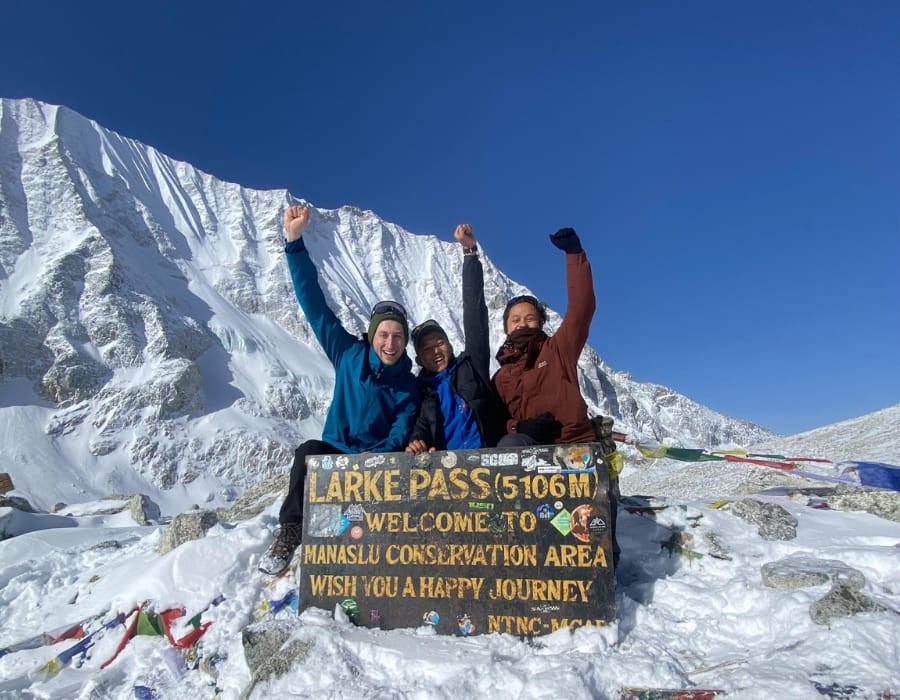
Need Help Planning Manaslu Circuit Trek or Tsum Valley, or both?
We understand that every trekker has a different pace, comfort level, and goal, so we customise each trek accordingly. Message us at our email or WhatsApp, and we will be happy to share a tailored itinerary and cost based on your needs. Contact Us Directly: Please feel free to Email [email protected] or WhatsApp +977 9851006023 (Bikesh) for questions, online briefing, bookings and inquiries.
Speak to an Expert
Can’t find what you’re looking for? Let our experts create a package just for you!
What Our Clients Say
Amazing trekking company
HET is an amazing trekking company. I signed up for two multi-week treks and Bikesh helped me find dates and then gave me a very transparent outline of costs. Before the trek, I had many...
P
Pamela
Manaslu Tsum Valley and Larke Pass and beyond
Earlier this year, my friend and I were fortunate enough to be part of a well-organised adventure to the Manaslu Tsum Valley and Larke Pass and beyond. Our very experienced and fun guides, Kuji and...
J
Jane
I had a great time with Bikesh and Team!
I hiked the Manaslu Trek with Bikesh, and it was a perfectly organised modern adventure. Even when one of us did get some problems because of the height in combination with a sickness he already had before...
A
Alex
Need Help? Call Us+977 9851006023